The critical distinction between IP65 and IP68 lies in water pressure and immersion duration. An IP65 enclosure perfectly defends against low-pressure rain and water jets, while an IP68 enclosure is completely submersible. Choosing correctly means aligning your enclosure's specific mechanical sealing capabilities with your exact deployment environment to prevent both catastrophic electronic failure and unnecessary budget overspending.
The Nightmare of Water Ingress in Field Electronics
For hardware engineers, system integrators, and product managers, few things are as stressful as deploying expensive electronic equipment outdoors. Water is relentless. A single drop of moisture bypassing a failed gasket can instantly short-circuit a critical PCB, resulting in data loss, operational downtime, and thousands of dollars in replacement costs.
Yet, when sourcing housings for these components, professionals often fall into the trap of misunderstanding Ingress Protection (IP) ratings. Under-specifying your housing leads to immediate field failures during the first heavy storm. Conversely, aggressively over-specifying can drastically inflate manufacturing costs, making your final product uncompetitive. To strike the perfect balance between reliability and cost-efficiency, you need a definitive waterproof rating guide to decode exactly what these numbers mean in real-world applications.
Decoding the Numbers: The First and Second Digits
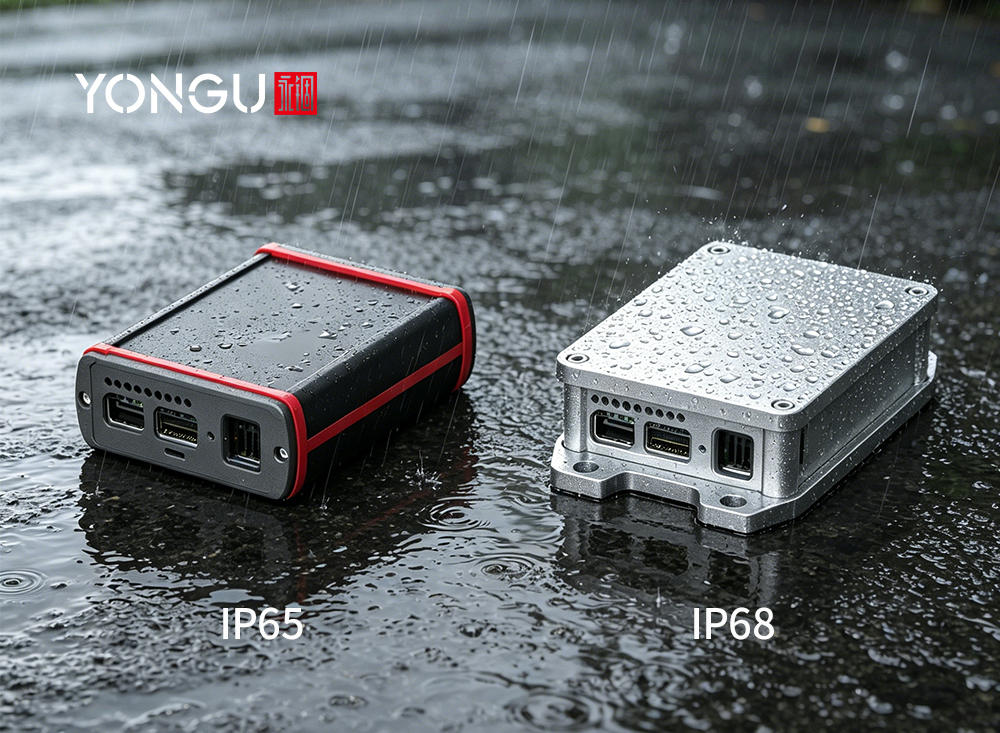
The "IP" system is an internationally recognized standard (IEC 60529). The first digit always indicates solid particle protection (dust), while the second digit dictates liquid ingress protection.
- The "6" (Dust-Tight): Both IP65 and IP68 share the highest possible rating for solid ingress. They are completely dust-tight, meaning no dirt, sand, or fine industrial dust can enter the casing under any circumstances.
- The "5" (Water Jets): A "5" means the enclosure can withstand low-pressure water jets from any direction. Think of heavy rainstorms, sprinkler systems, or light washdowns in a factory.
- The "8" (Submersion): An "8" indicates the enclosure is completely sealed against continuous, prolonged submersion in water under conditions specified by the manufacturer (usually up to 1 to 3 meters in depth).
The IP68 Enclosure Comparison vs IP65
To clearly illustrate the technical boundaries, we have compiled a quick reference table highlighting the operational differences:
| Feature | IP65 Enclosure | IP68 Enclosure |
|---|---|---|
| Dust Protection | Total protection (Dust-tight) | Total protection (Dust-tight) |
| Water Protection | Low-pressure water jets / Rain | Continuous deep water submersion |
| Testing Metric | 12.5mm nozzle, 30kPa pressure, 3 mins | Immersion beyond 1 meter (manufacturer defined) |
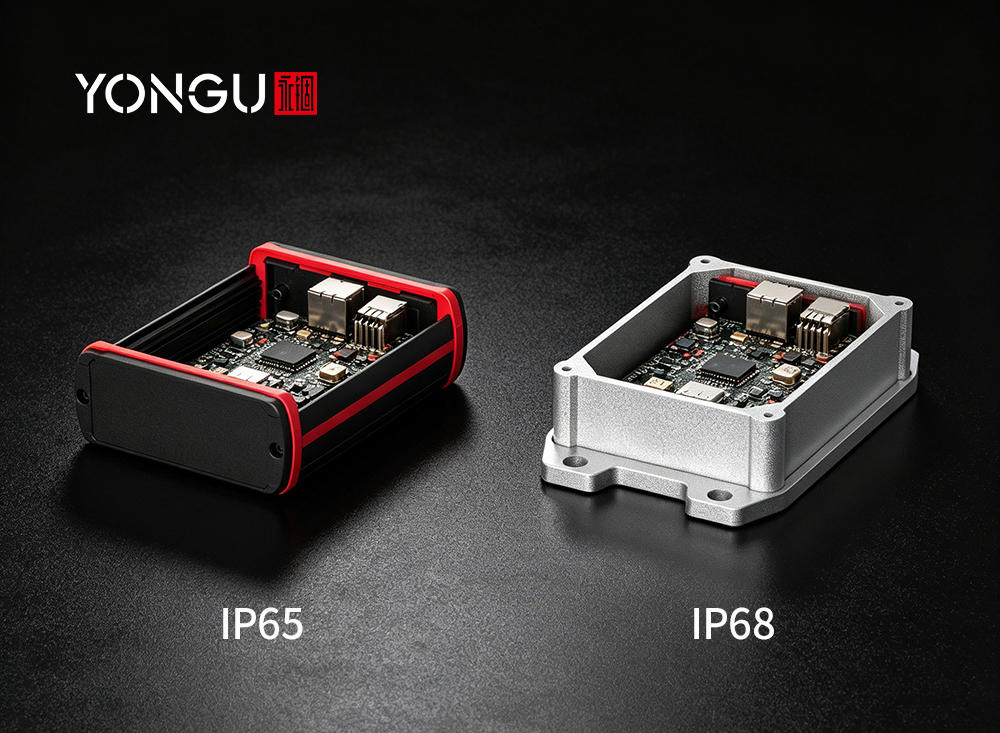
| Sealing Mechanism | Standard foam or basic rubber gaskets | Heavy-duty molded silicone / Dispensing seals |
| Ideal Application | Outdoor telecom boxes, street lighting | Marine sensors, underwater lighting, flood zones |
Bridging the Gap: Real-World Technical Scenarios
Imagine you are tasked with designing an environmental sensor hub for a coastal agricultural project. The primary requirement is that the device must survive frequent, aggressive rainstorms and daily irrigation sprinklers. An IP65 enclosure is functionally perfect here, allowing the housing to easily shrug off the surface water without ballooning your budget.
However, what if the installation site is situated in a low-lying valley prone to flash floods? Or what if your sensors need to monitor water quality directly inside a reservoir? If the water level rises and envelops the unit, the low-pressure seals of an IP65 box will fail under hydrostatic pressure. In this high-risk scenario, an upgrade is mandatory. The physical integrity of the CNC machining, the exact durometer of the silicone gasket, and the tightness of the fastening screws dictate the line between life and death for your circuitry.
This is the exact threshold where precision engineering becomes indispensable. To ensure foolproof protection, developers turn to professional-grade hardware providers. By leveraging YONGU's Waterproof Enclosures, engineers effortlessly resolve this dilemma. YONGU specializes in robust, extruded aluminum cases fitted with premium dispensing sealing technology that reliably achieves rigorous IP68 standards. Because they offer precise, custom CNC milling and strict quality control, your connectors and cable glands maintain absolute waterproof integrity. YONGU allows you to seamlessly transition your prototype from a basic rainproof concept into a fully submersible, military-grade field unit without the typical manufacturing headaches.
Frequently Asked Questions (FAQ)
1. Can an IP65 enclosure survive being dropped in a puddle?
An IP65 unit is only rated for directional water jets, not submersion. While a brief, accidental drop into a shallow puddle might not instantly destroy it if removed immediately, it is highly likely that water will seep past the gaskets if left submerged, damaging the internal electronics.
2. What should I look for in an IP68 enclosure comparison?
When conducting an IP68 enclosure comparison, carefully check the manufacturer's specific depth and time testing parameters. Because IP68 is loosely defined as "beyond IP67," one brand's IP68 might mean 1.5 meters for 30 minutes, while another might guarantee 3 meters for 24 hours. Always look for robust silicone gaskets and thick aluminum walls.
3. How does aluminum compare to plastic for waterproof enclosures?
While plastic is naturally rust-proof, extruded aluminum offers vastly superior mechanical rigidity. This stiffness prevents the enclosure from flexing under deep water pressure, ensuring the waterproof silicone gaskets remain tightly compressed. Aluminum also provides excellent thermal dissipation for high-power electronics.
Secure Your Hardware Against the Elements
Don't leave the survival of your cutting-edge electronics up to chance. Whether your deployment faces heavy rainfall or complete submersion in harsh environments, sourcing the perfectly rated chassis is paramount. Ready to weather-proof your next big project? Contact YONGU today to consult with our engineering team([email protected]), explore our fully customizable, high-performance waterproof enclosures, and safeguard your technology for a lifetime of flawless operation!