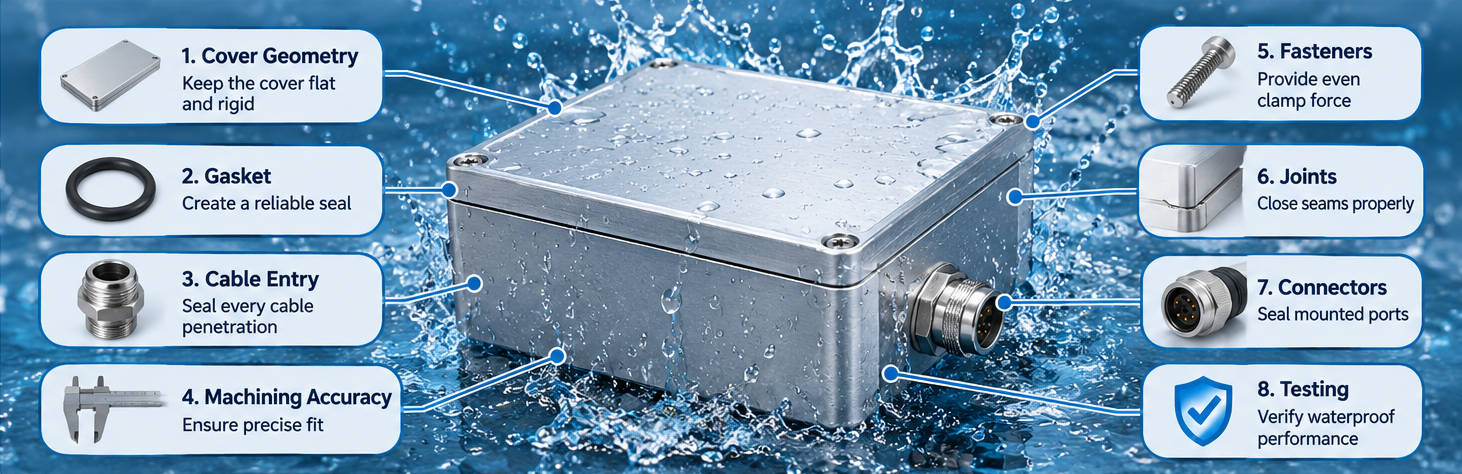
A waterproof aluminum enclosure is not made waterproof by one feature. It is made waterproof by eight design factors working as a closed loop: cover geometry, gasket, cable entry, machining accuracy, fasteners, joints, connectors, and testing. Each factor closes one path that water could take, and the rating is set by the weakest one — a perfect gasket over a warped cover still leaks, and a perfect groove in an untested batch still ships failures. This article explains what each of the eight factors does, why it matters, and what goes wrong when it is missing.
Waterproofing Is a System, Not a Feature
Water enters an enclosure through paths, not surfaces. Aluminum itself does not absorb water — the metal walls are barriers by nature. The vulnerabilities are at the interfaces: where the cover meets the body, where a cable passes through a wall, where a connector mounts, where two parts are joined. A waterproof design is the sum of the measures that close every one of those interfaces.
That is why "waterproof aluminum enclosure" is a design outcome, not a material property. Under IEC 60529:1989+AMD1:1999+AMD2:2013 CSV, the IP Code managed by TC 70, an IPX7 enclosure is one that survives 1 m immersion for 30 minutes — a test result that depends on how well all the interfaces hold, not on what the enclosure is made of.
The 8 Factors at a Glance
| # | Design factor | What it closes | What fails without it |
|---|---|---|---|
| 1 | Cover geometry | The lid-to-body opening | Bowed cover lifts the gasket off the flange |
| 2 | Gasket | The main perimeter seal | Under- or over-compression; aged seal fails |
| 3 | Cable entry | Every cable penetration | Water tracks along the cable jacket |
| 4 | Machining accuracy | Groove depth, flatness, hole position | Seal compression varies unit to unit |
| 5 | Fasteners | Clamp force distribution | Gaps between screws; uneven torque |
| 6 | Joints | Welds, end plates, assembled seams | Porosity or seam gaps let water in |
| 7 | Connectors | Panel-mounted ports | Connector body or mounting seal leaks |
| 8 | Testing | Proof that the first seven work | A sample passes; the batch does not |
1. Cover Geometry
The cover is the largest opening in the enclosure, and its geometry decides whether the gasket can seal at all. Two things matter: the mating flange must be flat, and the cover must stay flat under clamp load. A cover that bows between screws lifts away from the gasket, and the resulting gap is often only a fraction of a millimeter — invisible to inspection, wide enough for a water path under 1 m of immersion.
Good geometry means a machined flange with flatness under 0.05 mm, a cover thick enough (typically 3–5 mm aluminum) not to deflect, and ribs or a raised land where the opening is large. The geometry is fixed before assembly — no gasket can compensate for it afterwards.
2. Gasket
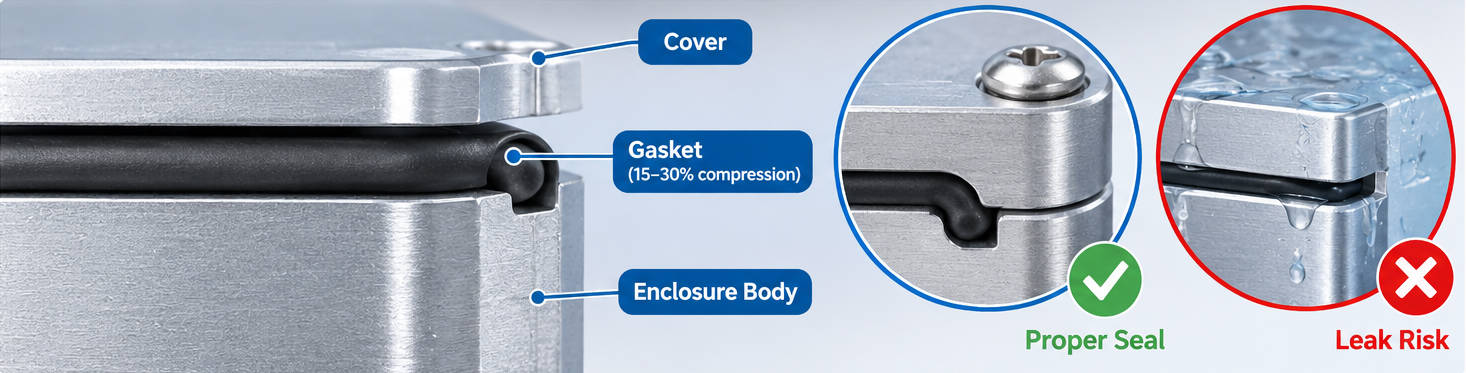
The gasket is the enclosure's main seal, and it works by compression, not by thickness. A static O-ring or molded gasket is designed to be squeezed into a defined band — typically 15–30% of its cord diameter — so that the rubber fills the gap by elastic force. Two failure directions bracket that band: too little compression leaves the seal resting rather than sealing; too much deforms the rubber permanently or shears it.
Material selection follows the environment. EPDM and silicone handle UV, ozone and temperature cycling; fluorocarbon grades (FKM) resist oils, fuels and higher temperatures; neoprene serves general outdoor duty. A thicker gasket does not mean better sealing — it means a groove that must be proportionally deeper and a cover that must clamp harder, and it often makes both worse.
3. Cable Entry
Cables are the most common water path in real installations, and they are always the factor customers underestimate. A hole through an aluminum wall is a tube; water does not need pressure to travel along a cable jacket through that tube. The answer is a rated cable gland — a gland whose seal squeezes the cable jacket and whose body seals to the enclosure wall, with a sealing washer at the mounting face.
Three details decide whether a cable entry holds: the gland's own IP rating should match the enclosure's immersion class, the cable diameter must sit in the middle of the gland's stated range (not at its edge), and the wall thickness must fall within the gland's clamping length so the gland seats flat instead of distorting.
4. Machining Accuracy
Sealing is a dimensional promise: the groove that holds the gasket is machined to a depth that sets its compression, and the flange around it is machined flat. If the groove is a tenth of a millimeter too shallow or too deep, the compression ratio moves by several percentage points, and the seal leaves its design band. That is why sealed enclosures are machined to tolerances far tighter than ordinary sheet-metal work — on our IP67/IP68 lines, sealing faces and grooves are held to ±0.05 mm, with machined surface roughness kept fine enough that tool marks do not form micro-channels under the seal.
Machining accuracy is also a batch question, not a sample question. An enclosure passes an immersion test as one unit; production ships as thousands. The dimension has to be repeatable, which is a process capability, not a lucky setup.
5. Fasteners
Screws deliver the clamp force that compresses the gasket, and their layout decides whether that force is even. Screws spaced too far apart let the cover deflect in between; uneven torque leaves one side of the gasket compressed and the other barely touched. A practical pattern is a screw every 60–80 mm along the seal line, with corner screws always present and a documented seating torque applied on every unit.
Material choice matters too. Using stainless steel screws in an aluminum body introduces a galvanic couple; where dissimilar metals must meet, insulating washers or compatible fastener grades prevent corrosion that would eventually loosen the clamp.
6. Joints
Aluminum enclosures are assembled from parts: an extruded body with machined end plates, a die-cast box with a separate cover, a welded shell. Every joint between parts is a sealing interface in its own right — a weld can be porous, an end plate seam flat but not sealed, and a mechanically tight joint can still pass water.
Sealed joints are built, not assumed: end plates carry their own gasket or sealant, welded shells are leak-tested rather than trusted, and joints are placed where water pressure is lowest. Extruded bodies with machined end plates reduce the number of joints compared with multi-part sheet-metal assemblies, which is one reason aluminum extrusion is the default construction for sealed enclosures.
7. Connectors
Any port on the panel — a power inlet, a data connector, a display window, an antenna fitting — is a penetration just like a cable. Panel-mounted connectors must have their own sealing: an O-ring or gasket at the mounting face, a body rated for the enclosure's environment, and a panel cutout machined to the connector's sealing footprint. A waterproof connector mounted on a badly cut hole leaks through the mounting flange, not through the connector.
The design rule is simple: no unsealed penetration of any kind. If a port does not need to be used, it should not be cut; if it does, it gets a rated connector with a sealed mounting interface.
8. Testing
The first seven factors are design intentions; testing is the proof. IEC 60529 defines the water tests an enclosure must survive, and the level claimed determines which test applies:
| Rating | Test condition (IEC 60529) | Typical exposure |
|---|---|---|
| IPX5 | Water jet, 6.3 mm nozzle, 12.5 L/min, 3 m distance | Washdown, rain with wind |
| IPX6 | Powerful jet, 12.5 mm nozzle, 100 L/min | Heavy spray, deck wash |
| IPX7 | Immersion, 1 m depth, 30 minutes | Temporary flooding |
| IPX8 | Continuous immersion, depth and time agreed with manufacturer | Submerged equipment |
Testing has two levels, and both matter. Type testing proves the design — a third-party immersion test on a representative unit. Production testing proves the batch — first-article inspection, dimensional sampling of groove depth, and assembly checks on every unit. A supplier that only shows a sample test report has proven the design; a supplier that also shows batch controls has proven the product.
Why Aluminum Is the Right Base Material
None of the eight factors is impossible in steel or plastic, but aluminum makes several of them easier. It machines to fine tolerances quickly, so grooves and flanges hold their dimensions; it forms its own oxide layer and anodizes into a durable finish that does not chip into a leak path; it conducts heat well, so a sealed enclosure without vents can still shed internal heat through its walls; and extrusion produces long bodies in one piece, minimizing joints. That combination — dimensional control, corrosion resistance, thermal performance, fewer seams — is why sealed enclosures for outdoor, marine, industrial and medical electronics are most often aluminum.
Four Myths About Waterproof Enclosures
- "A thicker gasket seals better." Compression ratio seals, not thickness. An oversized gasket needs a deeper groove and can extrude out of it.
- "IP68 on the label means IP68 in the field." The label reflects a test on a design; batch consistency depends on machining and assembly control.
- "The enclosure is sealed, so the electronics are safe." A sealed enclosure traps moisture from assembly — desiccant, venting membranes or dry assembly matter for long-term reliability.
- "Only the gasket needs attention." Seven other interfaces leak independently: entries, connectors, joints, fasteners and the cover geometry.
YONGU Waterproof Aluminum Enclosures
Our sealed ranges are built around these eight factors rather than around a gasket alone: extruded bodies with machined end plates and flanges, gasket grooves cut to ±0.05 mm, covers sized to the opening, IP68-rated cable entries and sealed connector interfaces. The IP68 waterproof aluminum enclosure range covers continuous-immersion applications, the IP67 range covers temporary immersion, the L-series profile enclosures are the reference for machined sealing features, and the MJ-series gateway boxes show the full sealed design in an outdoor product. Our L- and M-series carry third-party immersion test reports to IEC 60529 at 1.5 m — available on the downloads page. For a custom size, cutout or connector layout, the customization and machining service reviews your drawing against all eight factors before quoting; common questions are collected in the FAQ.

Waterproof Aluminum Enclosure FAQ
What actually makes an aluminum enclosure waterproof?
Eight design factors together: flat cover geometry, a correctly compressed gasket, sealed cable entries, accurate machining, an even fastener pattern, watertight joints, sealed connectors, and testing that proves both the design and the batch.
Is aluminum naturally waterproof?
The metal is a barrier, but the enclosure leaks at interfaces. Waterproofing comes from how the cover, gasket, entries, joints and connectors are designed and machined — not from the material alone.
What is the difference between IPX7 and IPX8?
IPX7 is a defined test: 1 m immersion for 30 minutes. IPX8 is continuous immersion at a depth and duration agreed between manufacturer and user, which is usually more demanding.
Can a sealed enclosure overheat?
It can, since a sealed box has no airflow. Aluminum's thermal conductivity lets the walls act as a heat path, and where more is needed, heat-sink enclosures or pressure-equalizing vents maintain both sealing and thermal performance.
How do I verify a supplier's waterproofing claim?
Ask for the type-test report (who tested, to which IEC 60529 level, at what depth and duration) and for production controls: machining tolerance on sealing features, first-article inspection, and batch sampling.
References
Rating definitions and water test conditions from IEC 60529:1989+AMD1:1999+AMD2:2013 CSV (Ed 2.2, TC 70); Edition 3 is in the ACD stage with a forecast publication date of 2027-12-31. Sealing design values (compression bands, fastener pitch, machining tolerances) follow standard enclosure engineering practice as applied on YONGU's IP67/IP68 lines. Related reading: Understanding IP Ratings from IP54 to IP68 and How to Choose IP65 vs IP67 for Outdoor Electronics.