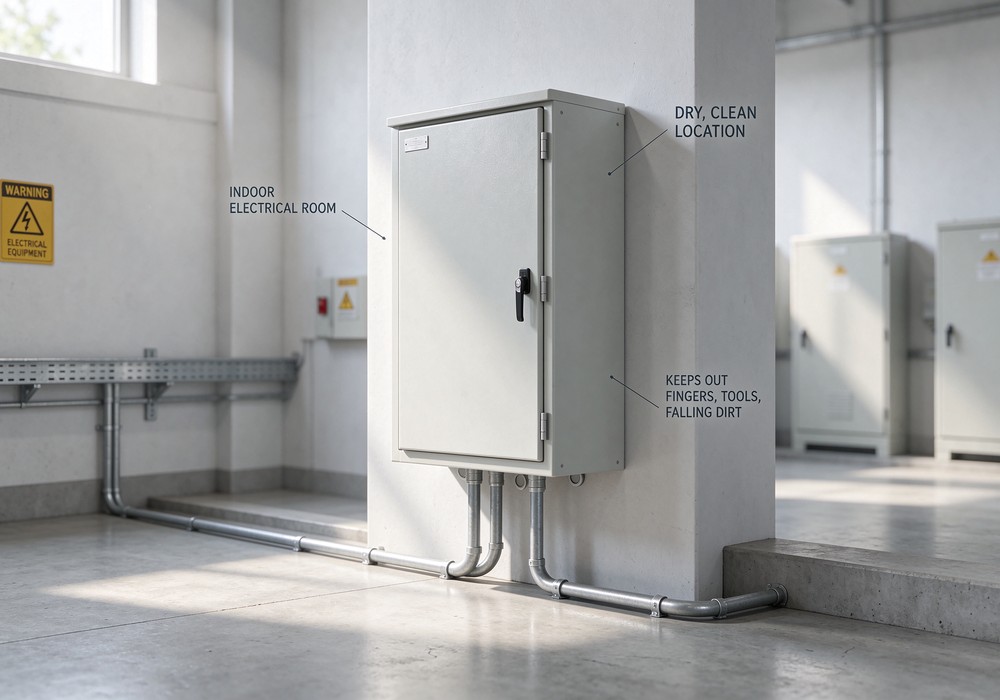
NEMA 1 is the lowest and most common enclosure classification in North America, and it is also the most misapplied. Type 1 covers indoor equipment against accidental contact with hazardous parts and against falling dirt — nothing more. It carries no requirement for dripping water, rain, washdown, circulating dust, oil, or corrosion resistance. Selecting it correctly comes down to one question: is the installation genuinely clean and dry?
What Does NEMA 1 Mean?
Type 1 is one of the enclosure types defined in the North American enclosure standard, now published as ANSI/NEMA EN 10250-2026 and previously designated ANSI/NEMA 250 (the 2020 edition was the last published under that number). The standard groups Types 1, 2, 5, 12, 12K, and 13 as indoor classifications and the 3-, 4-, and 6-series as indoor or outdoor classifications, with hazardous-location Types 7 and 9 handled separately.
The Type 1 definition, in the standard's own wording, covers enclosures "constructed for indoor use to provide a degree of protection to personnel against access to hazardous parts and to provide a degree of protection of the equipment inside the enclosure against ingress of solid foreign objects (falling dirt)." Two things matter in that sentence: the protection is a degree of protection rather than a sealed rating, and the only foreign-object condition named is dirt that falls in from above.
NEMA types are environmental categories, not a ladder. A higher number does not mean a better enclosure — Type 12 is an indoor industrial rating, Type 4 is an indoor/outdoor hose-down rating, and Type 6 covers submersion. Each describes the conditions it was evaluated against, and a product marked Type 1 has not been tested to any of the others.
NEMA 1 Protection Level
What Type 1 actually delivers is narrow and specific. It keeps fingers, tools, and incidental contact away from live or moving parts, and it keeps vertically falling dirt out of the enclosure. That is the full claim.
What it does not deliver is equally specific. Type 1 has no defined protection against dripping water or condensation, no protection against rain, snow, sleet, or splashing, no protection against hose-directed water, and no protection against circulating or settling industrial dust — it is not a dust-tight rating. It also carries no oil or coolant exclusion requirement and no added corrosion-resistance requirement; the "X" suffix in Type 4X is what denotes corrosion resistance, and Type 1 has no equivalent.
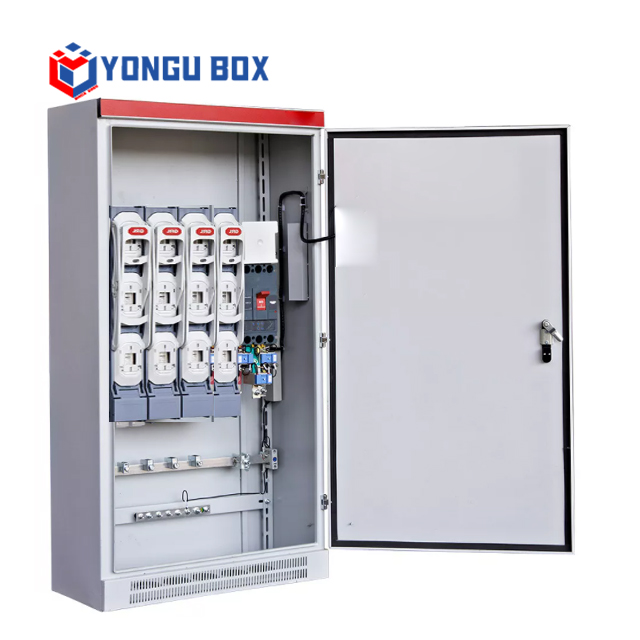
Construction follows from that. A Type 1 enclosure is typically an unsealed sheet-metal or extruded body with a cover or door that may be gasketed for general purposes but is not required to be, since no ingress test demands it. The once-common label "Type 1A" referred to a Type 1 box with a gasketed cover; it was dropped from the standard decades ago and is not a recognized rating today. Material is not prescribed either — powder-coated steel, galvanized sheet, stainless, aluminum, and nonmetallic bodies can all be marked Type 1 if they meet the construction requirements; the site's enclosure material guide compares them on cost and durability.
One practical consequence: a coating or a gasket does not upgrade the rating. A powder-coated Type 1 box is still Type 1. If the application needs corrosion resistance, the enclosure has to be evaluated and marked as 4X, not merely finished like one.
NEMA 1 vs NEMA 12 vs NEMA 4
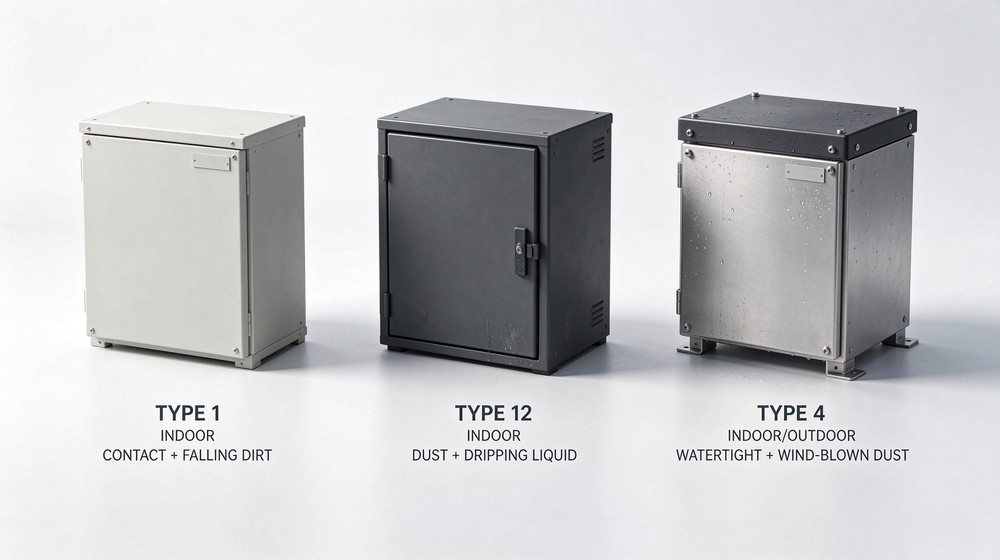
The three types overlap in appearance and diverge in what they were tested against. Type 1 is the baseline indoor rating. Type 12 keeps the indoor scope but adds protection against dust, falling dirt, and dripping non-corrosive liquids, and it must pass drip, dust, and rust-resistance tests — which is why it is the usual choice for a plant-floor cabinet with occasional condensation or light dust. Type 4 moves outdoors and adds a watertight claim: it must exclude at least 65 gallons per minute from a one-inch nozzle at a distance of not less than 10 feet for five minutes. Type 4X is the same watertight performance with added corrosion resistance.
| Type | Location | Core protection | Test basis |
| 1 | Indoor | Access to hazardous parts, falling dirt | Construction requirements only |
| 12 / 12K | Indoor | Dust, falling dirt, dripping non-corrosive liquid | Drip, dust, and rust-resistance tests |
| 4 | Indoor / outdoor | Watertight, windblown dust, rain and sleet | Hose test: 65 GPM, 1 in nozzle, 10 ft, 5 min |
| 4X | Indoor / outdoor | Type 4 plus corrosion resistance | Type 4 tests plus corrosion conditioning |
| 3R | Outdoor | Rain, sleet, snow; undamaged by ice | Weather exposure; not dust-tight |
The selection rule is direct. If the location is dry, clean, and free of dripping liquid, Type 1 is sufficient and costs the least. If condensation, light dust, or coolant mist is present but the equipment stays indoors, Type 12 is the correct step. If water is directed at the enclosure or the unit sits outdoors, only Type 4, 4X, or 3R applies — and 3R does not bring dust protection with it.
Typical Applications
Type 1 belongs in electrical rooms, mechanical spaces, and clean commercial buildings — distribution and terminal equipment, disconnect enclosures, junction and pull boxes, and indoor control assemblies installed away from process contamination. It is also the standard rating for equipment inside a larger, already-protected cabinet or a conditioned room where the enclosure itself sees nothing worse than dust settling from above.
The applications that disqualify it are easy to spot on a walk-through: washdown hoses on the wall, open cooling lines, machining centers within a few meters, floor drains that back up, roof leaks, or an uninsulated ceiling that drips in humid weather. Any of those means the box will see liquid, and Type 1 has no requirement to keep it out.
Limitations: When NEMA 1 Is Not Enough
The most expensive mistake with this rating is assuming that "indoors" means "protected." A NEMA 1 enclosure in a humid room will condense water on the inside of the cover, and the standard offers no defense — condensation is a liquid exposure the rating never addresses. The same applies to a washdown area, a food or beverage line, a laundry, a cooling tower room, or a building where the equipment is cleaned with a hose a few times a year.
Dust is the second gap. Type 1 excludes dirt that falls from above, not dust that circulates in the air. A woodworking shop, a cement or aggregate plant, a foundry, or any area with fine airborne particulate will push dust into an unsealed box, and the rating does not require it to stay out. Oil mist and coolant spray are a third: Type 1 has no oil exclusion requirement, so a box near a machine tool will accumulate fluid on the cover and eventually inside.
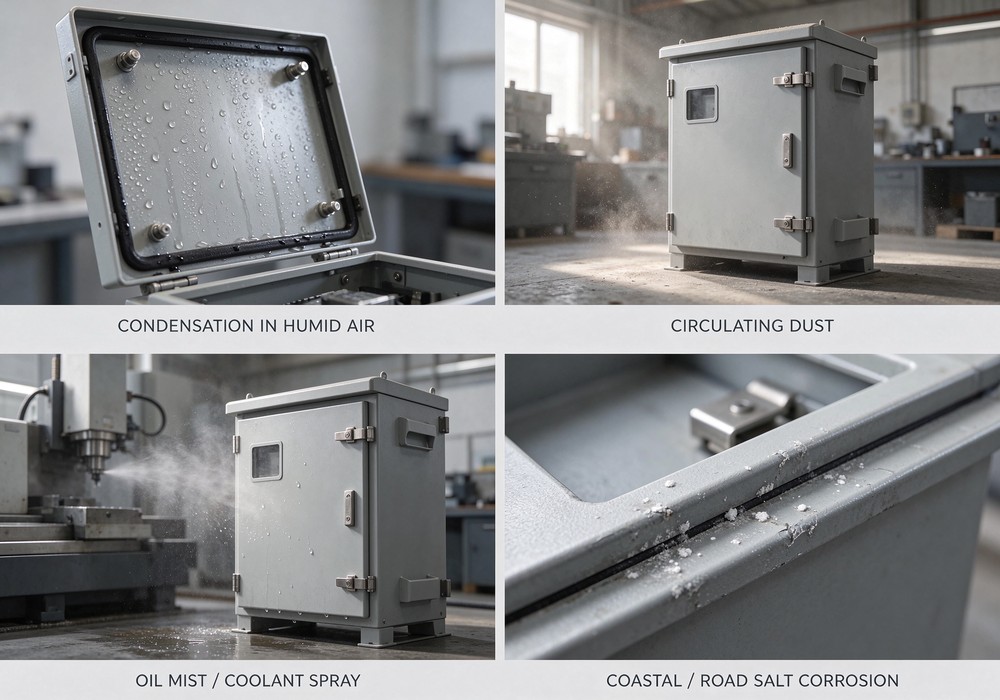
Corrosion is the fourth. An aluminum or coated-steel Type 1 body may look well finished, but without an X rating there is no evaluated corrosion performance, and coastal air, road salt, or chemical vapor will find the seams. Where any of these conditions exist, step to Type 12 for indoor industrial duty, Type 4 or 4X for water and corrosion, or 3R for sheltered outdoor mounting — and confirm the marking on the product, not the finish on the sample.
Aluminum NEMA 1 Enclosures
Aluminum is a legitimate body material for Type 1 equipment, and YONGU builds both enclosure styles that suit it. The H series is a split extruded body in 6063 aluminum — two machined halves, close tolerances, and easy access for assembly — in profiles from 69 × 30 mm (H47) up to 240 × 85 mm (H60). The J series is a one-piece extrusion with end panels, which keeps the part count low for volume builds.
Worth stating plainly: the body material does not create the rating. A Type 1 marking depends on construction — an unsealed cover, no ingress test obligation — and the same aluminum box with a gasketed lid, a proper groove, and a controlled joint is what a Type 12 or Type 4 design looks like. Aluminum helps with weight, thermal spreading, and finish options such as anodizing or powder coating; it does not substitute for sealing geometry. Buyers who need a documented rating should ask for the marking and the test basis rather than inferring it from the material.
For a broader view of how the types compare, the site's NEMA enclosure overview and the NEMA guide cover the full range, and NEMA versus IP explains why the two systems do not convert cleanly.
FAQs
What is a NEMA 1 enclosure?
An enclosure constructed for indoor use that provides a degree of protection to personnel against access to hazardous parts and to the equipment against falling dirt. It is the basic indoor general-purpose rating.
Is NEMA 1 waterproof?
No. Type 1 has no defined protection against dripping water, rain, splashing, or hose-directed water. For washdown or outdoor exposure, Type 4 or 4X applies; for indoor dripping liquid, Type 12.
Is NEMA 1 dust-tight?
No. It excludes solid objects that fall from above, not circulating or settling dust. A dust-tight requirement points to Type 12 for indoor use or Type 4 for indoor/outdoor.
Can NEMA 1 be used outdoors?
No. The standard scopes Type 1 to indoor locations. Outdoor mounting needs Type 3R at minimum for rain and snow, or Type 4/4X where water is directed at the enclosure.
Is a higher NEMA number always better?
No. NEMA types are environmental categories, not a ranking. Type 5 is an indoor dust rating that does not cover rain, while Type 3R covers weather but not dust. Match the type to the conditions present.
Does a gasketed cover make a Type 1 enclosure into Type 12?
No. The marking follows the tests the product was evaluated against. A gasket may improve real-world performance, but only an evaluated and marked Type 12 enclosure carries that rating.
Does an aluminum body change the NEMA rating?
No. The rating depends on construction and testing, not on the base material. Aluminum is chosen for weight, finish, and thermal behavior; sealing geometry and evaluation determine the type.
Choosing the Right Rating Before the Box
Type 1 is a good, inexpensive answer to a narrow question, and a costly wrong answer everywhere else. If the installation is dry, clean, and indoors, spec it with confidence. If there is any doubt about liquid, dust, oil, or corrosion, move up a type rather than hoping the finish covers it. Send the installation conditions, target rating, board or component dimensions, and quantity, and YONGU will confirm the cavity size, the sealing approach, and the finish that matches — with a stock sample first if the design is still moving. Start at the contact page; drawings and test reports are on the downloads page, and the supplier selection guide covers what to ask before ordering.