IP66 is one of the most specified enclosure ratings in North American and European industrial design, and also one of the most misunderstood. The rating comes from IEC 60529, the international standard for ingress protection, and it defines exactly how a housing performs against dust and water. In plain terms, an IP66 enclosure is dust-tight and withstands powerful water jets from every direction — but it is not rated for immersion. This guide breaks down the two digits, the test behind the rating, how IP66 compares with IP65 and IP67, and which YONGU aluminum enclosures fit IP66-level applications.
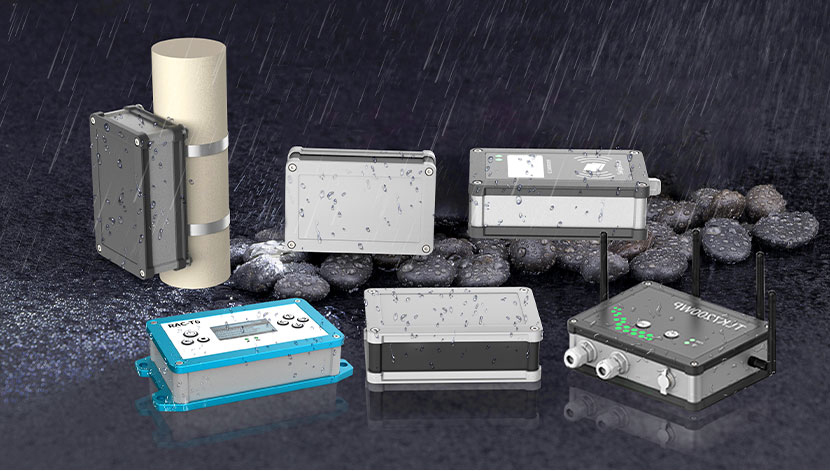
IP66 Rating Breakdown
First Digit 6: Complete Dust Protection
The first digit 6 means complete protection against dust ingress. Under IEC 60529, the enclosure sits in a dust chamber with talcum powder for eight hours while a vacuum draws air through the housing; for a rating of 6, no dust may enter at all. The lower level (5) allows some ingress as long as it does not interfere with the equipment. For outdoor electronics — sensors, relays, connectors and control boards — a dust-tight housing removes the most common failure path: abrasive, hygroscopic dust that shorts contacts and traps moisture.
Second Digit 6: Powerful Water Jets
The second digit 6 means the enclosure survives powerful water jets projected from all practical directions. This is a jet test, not an immersion test: water is sprayed through a 12.5 mm nozzle at 100 L/min from 3 m away for at least three minutes. It simulates heavy rain, hose-down cleaning and coastal spray. Compare that with IP65 (low-pressure water jets from a 6.3 mm nozzle at 12.5 L/min) and IP67 (temporary immersion in 1 m of water for 30 minutes) — the rating family covers very different real-world threats.
IP66 Testing Conditions
The IPX6 test in IEC 60529 is run with the equipment operating, under these conditions:
- Nozzle diameter: 12.5 mm, flow rate 100 L/min (±5%)
- Distance from nozzle to enclosure: 3 m
- Duration: at least 3 minutes
- Spray coverage: all practical directions, ±60° from vertical, enclosure tilted so every surface is exposed
A rating is only as trustworthy as the test report behind it. Request the actual IP test certificate rather than a printed specification: YONGU publishes an independent IP68 test report for its waterproof series, which follows the same IEC 60529 framework and gives a US spec review the evidence it needs. In North America, NEMA 4 is the equivalent rating class for hosed-down outdoor locations — see our NEMA vs IP rating guide and the NEMA enclosure guide to map the two systems.
IP66 vs IP65 vs IP67
| Rating | Dust protection | Water protection | Test summary | Typical use |
|---|---|---|---|---|
| IP65 | Dust-tight | Low-pressure water jets | 6.3 mm nozzle, 12.5 L/min, 3 m | Light rain, splash, indoor-outdoor transition |
| IP66 | Dust-tight | Powerful water jets | 12.5 mm nozzle, 100 L/min, 3 m, ≥3 min | Heavy rain, hose-down cleaning, washdown plants |
| IP67 | Dust-tight | Temporary immersion | 1 m immersion, 30 minutes | Flood-prone sites, occasional submersion |
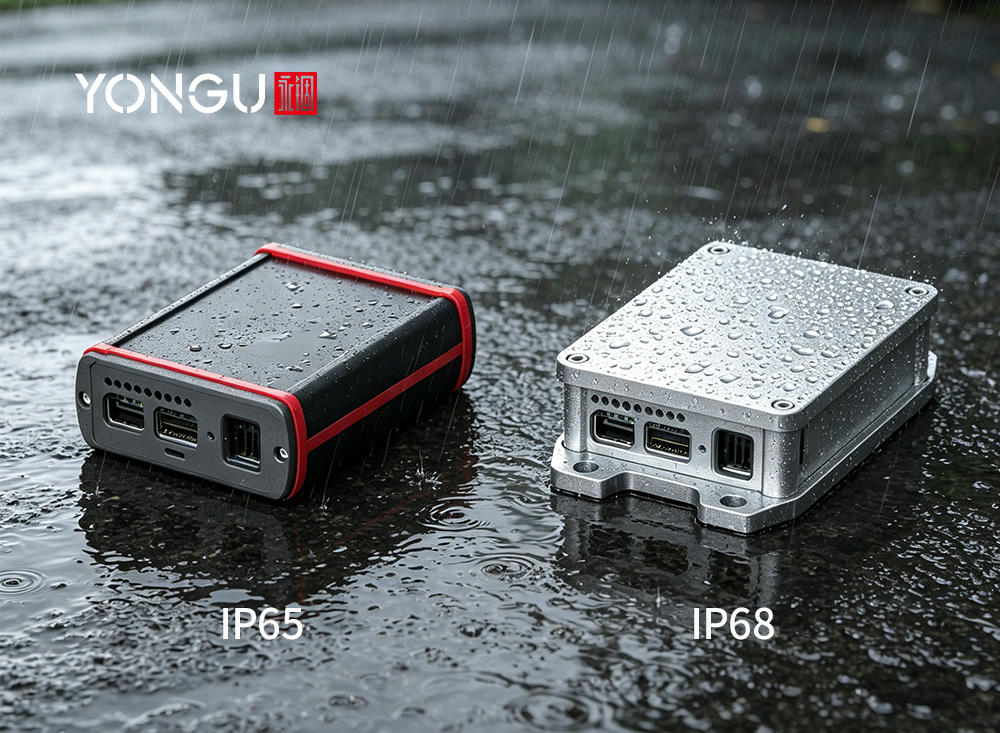
Choose IP65 for light outdoor and splash exposure, IP66 when the enclosure will face heavy rain or routine hose-down cleaning, and IP67 only when temporary flooding or submersion is a real risk — every step up in water rating adds gasket cost and thermal headroom. Our IP65 vs IP67 selection guide, IP65 vs IP68 comparison and the complete IP54–IP68 rating table walk through the full ladder.
Common Applications
- Outdoor telecom and IoT: gateway boxes, radio repeaters and street cabinets that sit in open rain — a natural fit for the MJ03 IoT gateway box and the IP67 aluminum enclosure range.
- Solar and EV infrastructure: charge controllers, inverters and battery boxes exposed to weather and washdown.
- Industrial washdown: food processing, chemical plants and machine tools where production floors are hosed down daily.
- Agriculture and irrigation: field controllers and pump stations in spray-heavy environments.
- Marine and coastal: wharf, harbor and deck electronics facing salt-laden spray — see the coastal salt-spray guide.
- Security and traffic: CCTV power boxes and roadside cabinets, covered by the waterproof junction box and wall-mount ranges.
Wherever the rating matters, also plan for condensation: a dust-tight, jet-proof box still breathes with temperature swings, and condensation prevention (breather vents, potting, conformal coating) keeps the inside dry even when the seal holds.
IP66 Aluminum Enclosure Options
YONGU builds waterproof aluminum enclosures around the same IEC 60529 discipline: extruded aluminum bodies, die-cast or machined end caps, O-ring and dispensing seals, and watertight construction verified by test. For IP66-class duty — dust-tight plus powerful jets — the following series are direct fits:
- M03 IP68 outdoor control enclosure — compact die-cast-style box for outdoor instrumentation.
- M11 IP68 current-control enclosure — larger format for power and control electronics.
- L01A extruded waterproof box — wall-mount form factor for sensors and gateways.
- T03 die-cast track enclosure — security and rail/transit duty with robust gasketing.
Browse the waterproof enclosure hub, the IP68 aluminum range, or the wall-mount waterproof boxes to match size and mounting. Every unit accepts custom cutouts, cable glands and gasket options, and the downloads page carries the IP68 test report, ROHS and REACH certificates for your compliance file. Tell us your target IP level and we will machine the openings and sealing details to hold it — contact YONGU with your application details.
FAQs
What is the difference between IP66 and IP67?
IP66 resists powerful water jets (12.5 mm nozzle, 100 L/min at 3 m) but is not immersion-rated; IP67 additionally survives temporary immersion in 1 m of water for 30 minutes. Choose IP66 for hose-down and heavy rain, IP67 when flooding or submersion is possible.
Is IP66 good for outdoor use in the United States?
Yes. IP66 covers dust-tight, heavy-rain and hose-down conditions and is comparable to a NEMA 4 style rating for non-corrosive outdoor locations; pair it with anodized aluminum for coastal corrosion resistance.
Can an IP66 enclosure be submerged?
No. A rating of 6 for the second digit covers powerful jets only. If submersion is possible, specify IP67 (1 m, 30 min) or IP68 for continuous immersion.
How long does the IPX6 water jet test last?
At least 3 minutes, with water at 100 L/min through a 12.5 mm nozzle from 3 m, sprayed from all practical directions while the equipment operates.
Does anodizing affect the IP rating?
No. The IP rating is achieved by the gaskets, O-rings and sealing geometry, not the surface finish. Anodizing adds corrosion and wear resistance that helps the enclosure hold its seal over years of outdoor service.
Where can I find an IP test report for evaluation?
YONGU publishes an independent IP68 test report (same IEC 60529 framework) on the downloads page, along with ROHS and REACH certificates. Request the specific IPX6/IPX7 test data with your RFQ if your program requires it — see our full FAQ page for more.