Most enclosure guides treat the housing as a protective box. In instrumentation it is something else: it is part of the measurement circuit. The enclosure determines how much interference reaches a microvolt-level thermocouple, how much leakage current creeps across a PCB feeding a high-impedance pH electrode, and how far the internal temperature drifts away from the 25 °C reference your accuracy specification was written against. A sensor that is perfectly sealed but badly housed will still produce bad numbers.
This guide approaches enclosure selection from the measurement side. It maps IP ratings to sensor location, works through shielding and grounding by signal type, addresses humidity and thermal stability, and closes with five vertical use cases for sensors, data acquisition (DAQ) and industrial control.

IEC 60529 and What the Rating Does Not Tell You
The IP code is defined in IEC 60529:1989, Edition 2.0, in consolidated form with Amendment 1 (1999) and Amendment 2 (2013) incorporated; the current stability date is 2027, and a third edition sits at the ACD stage with a forecast publication date of 2027-12-31 (IEC 60529, IEC webstore). Two digits: solids first, water second. For instrument housings the first digit is usually 6, and the second digit follows from where the electronics sit.
| Location of the electronics | Typical second digit | Reason |
|---|---|---|
| Sensor head on a machine, sheltered | IP54 to IP65 | Splash and dust only; no standing water |
| Field junction box, washdown zone | IP66 or IP67 | Powerful jets and temporary immersion |
| Transmitter head, outdoor process line | IP66 to IP67 | Rain plus process-side spray |
| Instrument cabinet or DAQ front end | IP54 minimum, IP65 if hosed | Dust and accidental water, mostly indoor |
| Submersible or tank-mounted sensor | IP68, with stated depth | Continuous immersion by agreement |
What the rating does not tell you is how well the housing behaves as an electrical enclosure. IP testing says nothing about shielding effectiveness, nothing about the leakage path across a wet internal surface, and nothing about the temperature inside the box when the sun is on it. Those three are the topics that follow, and they matter more to measurement accuracy than the second digit does.
Signal Integrity: Shielding and Grounding by Signal Type
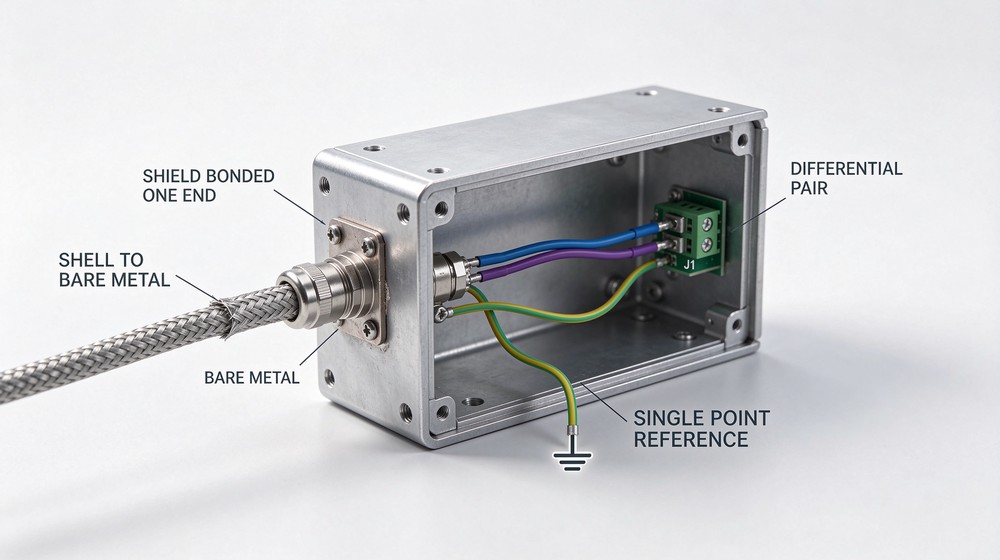
A metal housing is a shield only when it has a defined reference. An aluminum body attenuates external fields well, but if the circuit common, the cable shield and the chassis are not bonded at one coherent point, the housing becomes a floating conductor and can make noise coupling worse rather than better. The correct strategy depends on the signal level, and the levels vary by five orders of magnitude across a typical DAQ rack.
| Signal | Typical level | Housing and wiring requirement |
|---|---|---|
| 4–20 mA loop | 16 mA span | Current-mode, largely immune to lead resistance; shielding optional, loop isolation matters |
| Thermocouple | Tens of µV per °C | Full shielding; isothermal terminals; avoid dissimilar-metal junctions in the housing |
| RTD, 3- or 4-wire | Milliohms per °C | Lead compensation; stable contact resistance at terminals |
| Strain-gauge bridge | mV/V full scale | Excitation stability; shield tied to bridge common, not to chassis earth |
| IEPE accelerometer | mV/g, to 10 kHz | Triboelectric and ground-loop noise dominate; bonded connector shells, single-point earth |
| pH, ISE, conductivity | 10⁸ to 10⁹ Ω source | Surface leakage is the enemy: dry internal atmosphere, conformal coat, guarded input traces |
The practical rules compress into three. Terminate the cable shield at one end and let the other end float, so the shield cannot carry a circulating current between two earths. Bond the connector shell to the housing metal, not to a painted surface. And if a signal is differential, keep the pair together inside the box as well as outside it, because a split pair picks up noise on the last 100 mm just as readily as on the first 100 m.
Humidity, Leakage and High-Impedance Inputs
A sealed enclosure solves rain and stops nothing else. Water vapour present at assembly stays inside, and on a temperature swing it condenses on the coldest surface — usually the metal wall, sometimes the board. For most digital electronics that is harmless. For a pH or ion-selective input running at 10⁹ Ω source impedance, a thin film of moisture across the PCB is a parallel resistor of the same order as the electrode, and the reading drifts without any fault appearing.
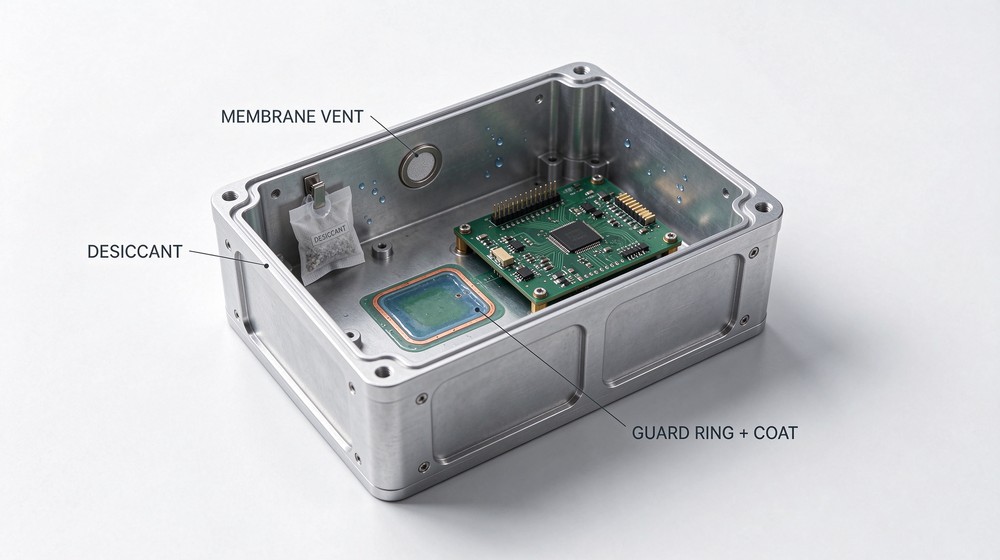
- Dry the internal atmosphere. A desiccant sachet with a defined service interval, or a breathable membrane vent that equalizes pressure while blocking liquid water, keeps the interior below the dew point for longer.
- Protect high-impedance nodes. Conformal coating on the input section, guard rings around the electrode trace, and a standoff distance from the housing wall are design measures, not enclosure measures — but the enclosure sets the humidity they must survive.
- Do not vent a washdown housing. A membrane vent is right for a sealed outdoor box with internal temperature cycling and wrong for an IP66/IP67 housing that faces direct jets; place the vent where it never sees spray.
Thermal Stability and Accuracy Specifications
Almost every DAQ accuracy figure in a datasheet is referenced to an ambient of 25 °C, plus a temperature coefficient per degree above it. That means the enclosure has two jobs: keep the internal temperature close to ambient in still air, and avoid creating local hot spots that make one channel read differently from its neighbour.
Aluminum helps on both counts. A 6063 extrusion at roughly 200 W/(m·K) spreads heat from the regulator and the processor across the whole body, and a machined base plate in contact with a steel panel turns the panel into additional sink area. What defeats it is solar gain on a dark painted lid — surface temperature can run 20 °C or more above air temperature in direct sun — and stacked channel density in a DAQ front end where twenty modules share one box with no internal air movement. In those cases the answer is a light finish, a standoff gap to the mounting surface, and a chassis that conducts to a cold structure rather than relying on the internal air.
There is also a measurement-specific thermal effect that has nothing to do with the electronics: thermoelectric voltages. A copper terminal block bolted to an aluminum body forms a junction pair, and if the two ends sit at different temperatures the pair generates a microvolt offset that lands directly on a thermocouple channel. Keeping terminations isothermal, and avoiding long aluminium paths between them, matters more than the absolute temperature.
Five Vertical Use Cases
| Use case | Environment | Rating | Dominant risk | Enclosure requirement |
|---|---|---|---|---|
| Process transmitter head | Wet plant, washdown | IP66–IP67 | Spray at the cable entry | Bottom entry, sealed gland, machined flat joint |
| Environmental and air-quality station | Outdoor, UV, daily cycling | IP65–IP66 | Condensation on cold nights | Membrane vent, sunshield, UV-stable gasket |
| Machine condition monitoring | Vibration, oil, EMI | IP65–IP67 | Ground-loop and triboelectric noise | Rigid cast or machined body, bonded shells, strain relief |
| Weighing and load cells | Food, packaging, washdown | IP66–IP67 | Moisture at the summing junction | Sealed junction box, isolated bridge common |
| Multi-channel DAQ front end | Cabinet, rack, test cell | IP54–IP65 | Channel-to-channel thermal and noise coupling | Conductive body, connector panel, internal partitioning |
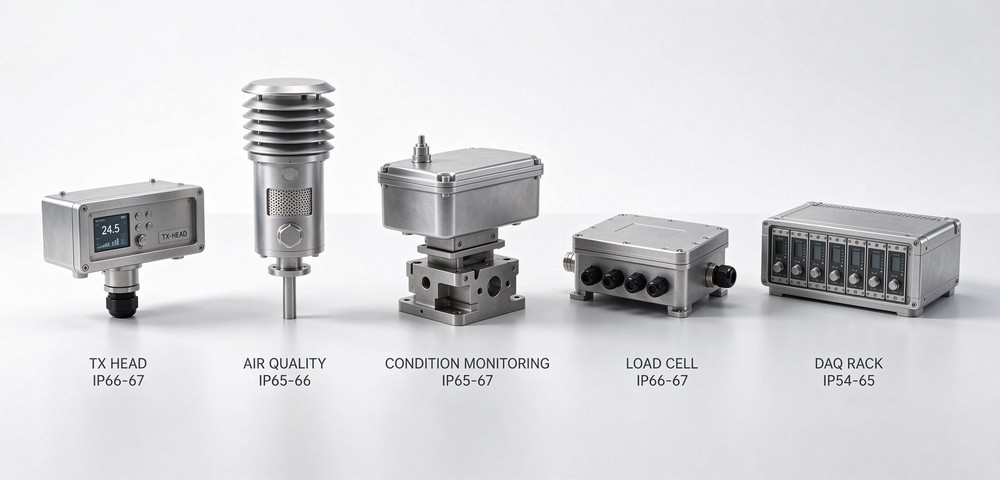
Two of these deserve a closer note. Condition monitoring is the case where housing rigidity matters for signal quality: an accelerometer stud-mounted on a thin folded cover will measure the cover's resonance as much as the machine's vibration, so the housing should be cast or machined with a solid mounting pad. And a multi-channel DAQ front end is a thermal and grounding problem at once — twenty channels in a sealed box share one internal air volume, so the shielding partition that separates a millivolt channel from a switching regulator is doing measurement work, not just packaging.
Design Details That Decide Field Reliability
- Specify the IP rating together with the test depth, duration and laboratory, not as a bare two-digit claim.
- Machine the sealing groove to a tolerance that keeps gasket compression inside its range, typically ±0.05 mm on the groove depth.
- Keep lid fastener pitch at 60 to 80 mm so the gasket load stays even along the joint.
- Bond every connector shell and every gland to bare metal, with the paint broken at the contact face.
- Route cable entries at the lowest face and add a drip loop; a perfect gland under standing water still leaks.
- State the assembly torque for lid screws and gland nuts, and inspect it at first article.
- Label channels on the outside of the housing; a field engineer who opens the wrong cover in the rain costs more than the label.
YONGU Enclosures for Sensors and Data Acquisition
The IP67 aluminum enclosure range covers field junction and transmitter housings with machined sealing faces and gland-ready end walls; the IP68 waterproof range extends to tank-mounted and submersible instruments, tested by Bureau Veritas to IEC 60529 at 1.5 m immersion with the report on the downloads page. The L-series profile housing is the practical choice for compact sensor heads where internal PCB rails remove the need for standoffs, and the M01 unibody housing gives a single-piece body for high-impedance front ends where a split line is one more humidity path. Connector panels, sensor windows and mounting pads are produced on custom CNC machining across 160+ machines and 14 production lines, with 6061 and 6063 bodies finished by anodizing or powder coating. Related reading: custom aluminum sensor housing and choosing sensor enclosures. General questions are answered on the FAQ page.
Industrial Sensor Enclosure FAQ
Does an aluminum enclosure improve measurement accuracy?
It can. The metal body shields low-level signals and spreads heat so the internal temperature stays nearer the reference your accuracy spec assumes. Neither effect is automatic — both depend on bonding and mounting detail.
Why do high-impedance sensors fail in sealed boxes?
Because sealing traps the moisture that was inside at assembly. On a pH or ISE input at 10⁹ Ω, a humidity film across the PCB becomes a leakage path comparable to the electrode itself, and the reading drifts with no visible fault.
Should the cable shield be connected to the enclosure?
Connect it at one end only, and bond the connector shell to bare housing metal. Connecting both ends creates a circulating current between earths that injects noise instead of removing it.
What IP rating does a DAQ cabinet need?
IP54 is adequate for a clean instrument room; move to IP65 where hosing or dusty air is present. The rating protects the electronics, while shielding and thermal design protect the measurement.
Can an IP68 housing be used indoors for a bench instrument?
Yes, and it is often the right choice for washdown laboratories, but a fully sealed body without a vent will trap heat. Confirm the internal temperature rise against the accuracy specification before assuming the higher rating is free.
References
Ingress protection definitions and test conditions: IEC 60529:1989 (Edition 2.0, consolidated with AMD1:1999 and AMD2:2013), degrees of protection provided by enclosures, TC 70. Signal-level and grounding guidance reflects standard instrumentation practice for thermocouple, RTD, bridge, IEPE and high-impedance electrochemical inputs. Product tolerances and immersion test reports referenced above are published on yg-enclosure.com.