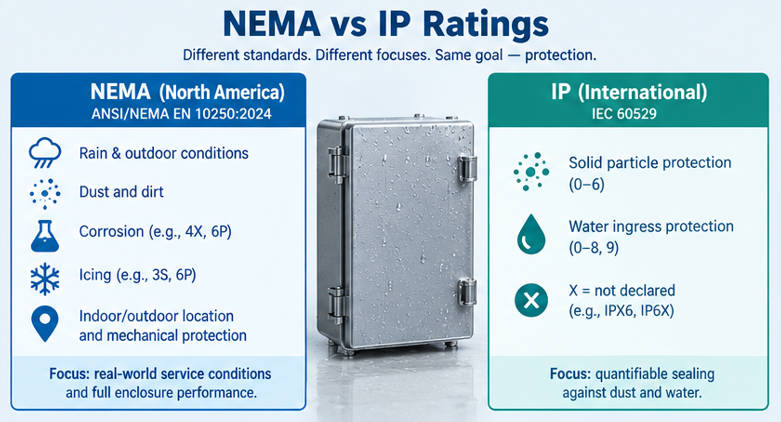
NEMA and IP are the two enclosure rating systems engineers must reconcile when specifying housings for electrical and electronic equipment. NEMA ratings, defined in North America, describe the environment an enclosure can survive; IP (Ingress Protection) ratings, defined by IEC 60529, describe quantifiable protection against dust and water. They overlap but are not interchangeable, and a direct one-to-one conversion does not exist. This guide explains both systems, how their test methods differ, provides the most complete NEMA-to-IP and IP-to-NEMA conversion charts, and tells you which standard to cite by region — so you can specify the right YONGU aluminum enclosure the first time.
What Are NEMA Ratings?
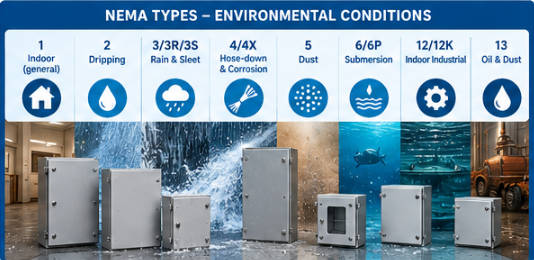
NEMA (National Electrical Manufacturers Association) enclosure ratings classify protection against the environmental conditions typical of U.S. industrial sites. The governing document has long been NEMA 250, now maintained as ANSI/NEMA EN 10250:2024 (published February 2025). A NEMA type is defined by the situations it withstands — indoor drips, falling rain, sleet, dust, hose-directed water, corrosion, or temporary submersion — rather than by a strict numeral scale. That is why NEMA types carry letters and suffixes: 1 (indoor, general), 2 (indoor, dripping), 3/3R/3S (outdoor, rain and sleet), 4/4X (hose-down and corrosion-resistant), 5, 6/6P (submersible), 12/12K and 13 (indoor industrial, dust and dripping liquid or oil). Because NEMA bundles location, mechanical and corrosion requirements into one type, it remains the expected spec for North American electrical contractors and inspectors. For a full walkthrough, see our What Is a NEMA Enclosure? and Guide to NEMA Enclosures.
What Are IP Ratings?
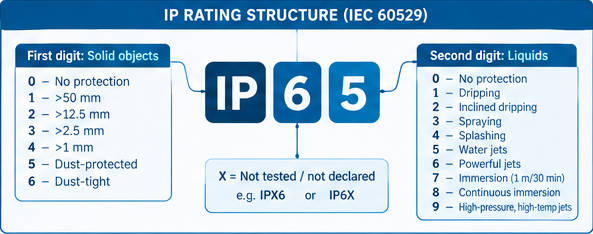
IP ratings follow IEC 60529, the international standard prepared by IEC Technical Committee 70 — currently Edition 2.2 (2013, consolidated with Corrigendum 2:2015), with Edition 3 under revision. The code is built from two numerals plus optional letters: the first digit rates protection against solid objects from 0 (no protection) to 6 (dust-tight); the second rates liquid ingress from 0 to 8 (continuous immersion under conditions agreed between manufacturer and user) and 9 (high-pressure, high-temperature water jets). An X replaces either digit when a level is not declared, as in IPX6 or IP6X. Unlike NEMA, the IP code does not cover corrosion, icing, or specific indoor/outdoor locations — it tests only the enclosure's sealing behavior. IP ratings are the default on equipment built for Europe, Asia, and most global export markets, and they are the format most OEM buyers use when specifying waterproof aluminum boxes. Start with What Is Ingress Protection? and our IP54 to IP68 selection guide.
Key Differences in Testing Standards
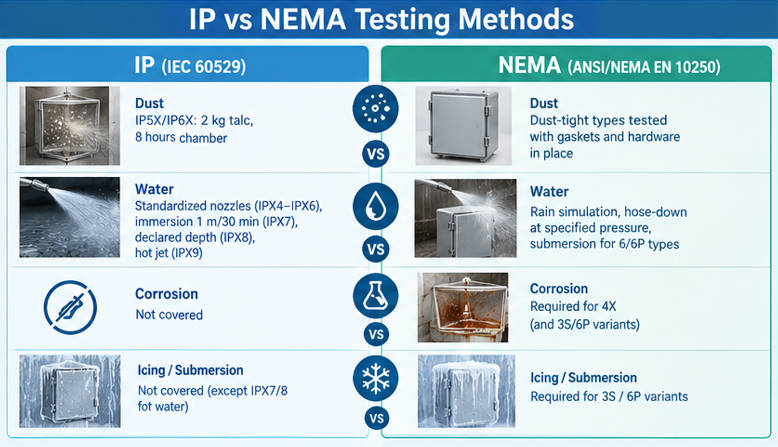
The two systems test differently, which is why conversion is approximate. IP tests (IEC 60529) apply calibrated probes and standardized jets to the enclosure alone: dust via a talc chamber (2 kg, 8 hours) for IP5X/IP6X, water via nozzle tests for IPX4–IPX6, immersion at 1 m for 30 minutes for IPX7, and agreed depth/duration for IPX8. NEMA tests (NEMA 250 / ANSI/NEMA EN 10250) verify a complete working enclosure — gaskets, hinges, latches, drains and knockouts included — against simulated outdoor conditions, hose-down at specified pressure, corrosion and icing for the types that claim them. The practical consequences: a NEMA 4X box is more than an IP equivalent because it must also resist corrosion and ice; an IP68 rating can exceed NEMA 6P because continuous immersion depth and time are declared by the manufacturer. In short, IP quantifies sealing; NEMA certifies real-world service. For guidance on choosing between common levels, see IP65 vs IP67 and IP65 vs IP68.
| Test dimension | IP (IEC 60529) | NEMA (250 / EN 10250) |
| Dust | IP5X/IP6X: 2 kg talc, 8 h chamber | Dust-tight types tested with gaskets and hardware in place |
| Water | Standardized nozzles (IPX4–IPX6), immersion 1 m/30 min (IPX7), declared depth (IPX8), hot jet (IPX9) | Rain simulation, hose-down at specified pressure, submersion for 6/6P types |
| Corrosion | Not covered | Required for 4X (and 3S/6P variants) |
| Icing / sleet | Not covered | Included for outdoor types 3, 3R, 3S, 4, 4X, 6, 6P |
| Unit tested | Enclosure shell | Complete enclosure with gaskets, hardware, drains |
| Scope | Sealing only | Sealing plus location, corrosion and icing |
NEMA to IP Conversion Chart
The table below lists each common NEMA type and its closest IP equivalent based on the protection each standard actually tests. Treat every row as "similar protection under typical conditions," not an exact match — a NEMA 4X enclosure still adds corrosion and ice resistance that no IP code claims, and an IP68 box may declare deeper or longer immersion than NEMA 6P. NEMA 3R and IP14 are the pairing most often cited by NEMA's own guidance, while NEMA 12 maps to approximately IP54 per NEMA's published comparison (NEMA EN P1-2020); other rows follow the widely used engineering cross-reference.
| NEMA type | Closest IP | Notes |
| NEMA 1 | IP10 | Indoor, hand protection only |
| NEMA 2 | IP11 | Indoor, dripping liquid |
| NEMA 3 | IP54 | Outdoor, rain and dust |
| NEMA 3R | IP14 / IP54 | Rain-tight outdoor; IP14 per NEMA guidance |
| NEMA 3S | IP54 / IP56 | Rain, sleet, external icing |
| NEMA 4 | IP56 | Hose-down, dust-tight, indoor/outdoor |
| NEMA 4X | IP66 / IP67 | NEMA 4 plus corrosion resistance |
| NEMA 5 | IP52 | Indoor, dust and falling water |
| NEMA 6 | IP67 | Temporary submersion |
| NEMA 6P | IP67 / IP68 | Prolonged submersion, corrosion options |
| NEMA 12 | IP52 / IP54 | Indoor, dust and dripping liquid |
| NEMA 13 | IP54 | Indoor, oil and coolant spray |
IP to NEMA Conversion Chart
Working in the reverse direction, pick the NEMA type whose tested conditions match your IP level — then add the NEMA dimensions IP does not cover. IP54 gives indoor industrial protection close to NEMA 12 and rain-tight service near NEMA 3; IP56 approaches NEMA 4/4X hose-down duty; IP67 corresponds to NEMA 6 temporary submersion; IP68 goes beyond NEMA 6P only when the declared immersion depth and time are specified. Remember that no IP rating implies corrosion resistance — in coastal or washdown environments you still need an anodized or stainless solution, which is exactly the gap NEMA 4X fills. Our IP68 outdoor enclosure guide and IP68 buyer's guide explain the sealing details behind these numbers.
| IP rating | Closest NEMA | What NEMA adds |
| IP54 | NEMA 3 / 12 | Sleet/ice (3) or indoor dust+drip (12) |
| IP55 | NEMA 3 / 3S | Rain-tight outdoor service |
| IP56 | NEMA 4 / 4X | Hose-down certification; corrosion with 4X |
| IP65 | NEMA 4 / 4X | Hose-down duty, dust-tight |
| IP66 | NEMA 4X | Stronger jet resistance; corrosion only with 4X |
| IP67 | NEMA 6 / 6P | Temporary vs prolonged submersion |
| IP68 | NEMA 6P | Declared immersion depth/time; corrosion options |
Which Standard to Use by Region
Specify the standard your customer, code, or market expects. In North America, electrical contractors, inspectors and UL-listed panel builders work in NEMA types — a wall-mounted control box for a U.S. plant should carry NEMA 12 for indoor or NEMA 3R/4X for outdoor duty, with an IP equivalent listed for cross-reference. In Europe, the Middle East, Asia and most export projects, IP (IEC 60529) is the working language, and the IP code is printed on the data plate. If your equipment ships globally from a U.S. design, dual-marking is the clean answer: NEMA 4X with IP66, or NEMA 12 with IP54, stated side by side. Two decisions matter more than the label: whether the site is indoor or outdoor, and whether corrosion, ice or washdown is a real risk — those dimensions belong to NEMA, and IP alone cannot express them. For outdoor deployments, our IP68 outdoor reliability guide and the wall-mount waterproof box range show how sealed aluminum enclosures are built; the wall-mount aluminum enclosure collection covers outdoor-rated options for field equipment.
Common Misconceptions
1. "IP54 equals NEMA 3R." Partially — NEMA 3R adds ice and sleet survival that IP does not test, while IP54 adds dust ingress limits NEMA 3R does not claim. They are similar for rain-tight duty, not identical.
2. "The third IP digit is mechanical impact." No. IP is two digits plus optional letters; mechanical impact is a separate IK code (IEC 62262).
3. "NEMA 4 is the same as IP66." Not exactly — NEMA 4 is a complete-assembly, hose-down, dust-tight test; IP66 is a shell test under a specific jet. Treat NEMA 4X as "IP66-class plus corrosion and ice."
4. "IP68 always beats NEMA 6P." Only if the declared immersion depth and time are stated; an unqualified IP68 carries no defined submersion condition.
5. "NEMA is only for the U.S." NEMA remains the norm for U.S.-bound equipment, but global OEMs routinely dual-mark, and an IP-only spec may fail a U.S. plant review.
6. "Higher numbers are always better." Over-specifying adds gasket, fastener and cost burden; match the rating to the actual environment. Selecting the right level for industrial boxes is covered in IP68-rated outdoor enclosure boxes and IP68 heat-dissipating enclosure solutions.
Get the rating right before you order. Tell YONGU your installation site (indoor or outdoor), climate, washdown or submersion exposure, and target standard — we will match a sealed aluminum enclosure and provide the IP test report and material finish that fit. Our IP67/IP68 waterproof aluminum profile enclosure (L06A, 150 × 115 mm) is a typical outdoor-rated example, with anodized finishes and custom cutouts available, MOQ from one unit. Request a quote through the contact page; datasheets and IP68 test reports are on the downloads page.
FAQs
What is the difference between NEMA and IP ratings?
NEMA (250 / ANSI/NEMA EN 10250) rates a complete enclosure against U.S. industrial environments — indoor/outdoor location, dust, rain, sleet, hose-down, corrosion and submersion — while IP (IEC 60529) rates the shell's dust and water sealing with two digits. NEMA covers corrosion and icing; IP does not.
What IP rating is equivalent to NEMA 4X?
The closest equivalents are IP66 (strong jets) or IP67 (temporary immersion). NEMA 4X additionally requires corrosion resistance, so for coastal or chemical sites specify anodized or corrosion-resistant material — no IP number alone covers that dimension.
Is NEMA 12 the same as IP54?
Approximately, for indoor dust and dripping liquid duty — NEMA's own comparison maps NEMA 12 to about IP54. NEMA 12 is defined for complete assemblies indoors; IP54 is a shell sealing level with no location or corrosion requirement.
Which is better, NEMA or IP?
Neither — they serve different markets and test different things. Use NEMA for U.S. code and contractor workflows, IP for international and OEM export specifications, and dual-mark when equipment crosses regions. Match the rating to the real environment rather than picking the "higher" number.
Do I need both NEMA and IP ratings?
For U.S. plants, NEMA types satisfy local practice; for global projects, IP is expected. Dual-marking (for example NEMA 4X / IP66) is common on export equipment and removes ambiguity about what the enclosure actually withstands.
What does IP68 mean compared to NEMA 6P?
IP68 means dust-tight plus continuous immersion under depth and duration agreed with the manufacturer; NEMA 6P means prolonged submersion with corrosion-resistant options. Always request the declared immersion conditions, because neither label has a fixed depth or time.