NEMA enclosure ratings tell you exactly what an electrical housing can survive: falling dirt, dripping water, rain, hose-down, submersion, corrosion, ice, or explosive atmospheres. This guide is the complete reference for the U.S. market — every NEMA type from 1 to 13, its indoor/outdoor use, its closest IP equivalent, and the aluminum enclosure YONGU ships for that duty. Whether you are specifying a wall-mounted control box, an outdoor sensor housing, or a washdown-rated instrument chassis, this chart and the selection rules below give you the rating decision in minutes.
What Are NEMA Enclosure Ratings?
NEMA (National Electrical Manufacturers Association) enclosure types classify the protection an enclosure provides against its environment. The governing standard, historically NEMA 250, is now published as ANSI/NEMA EN 10250:2024 (effective February 2025). Unlike the IP code's two numeric digits, a NEMA type is an environment specification: it bundles indoor or outdoor use, dust, water, corrosion, icing, and — for types 7 through 10 — hazardous-location protection into one label. NEMA ratings are the default language of U.S. electrical contractors, inspectors, and UL-listed panel shops; when you ship equipment to North America, the data plate carries a NEMA type. For the basics, start with What Is a NEMA Enclosure? and the NEMA enclosure guide.
Complete NEMA Rating Chart (Type 1–13)
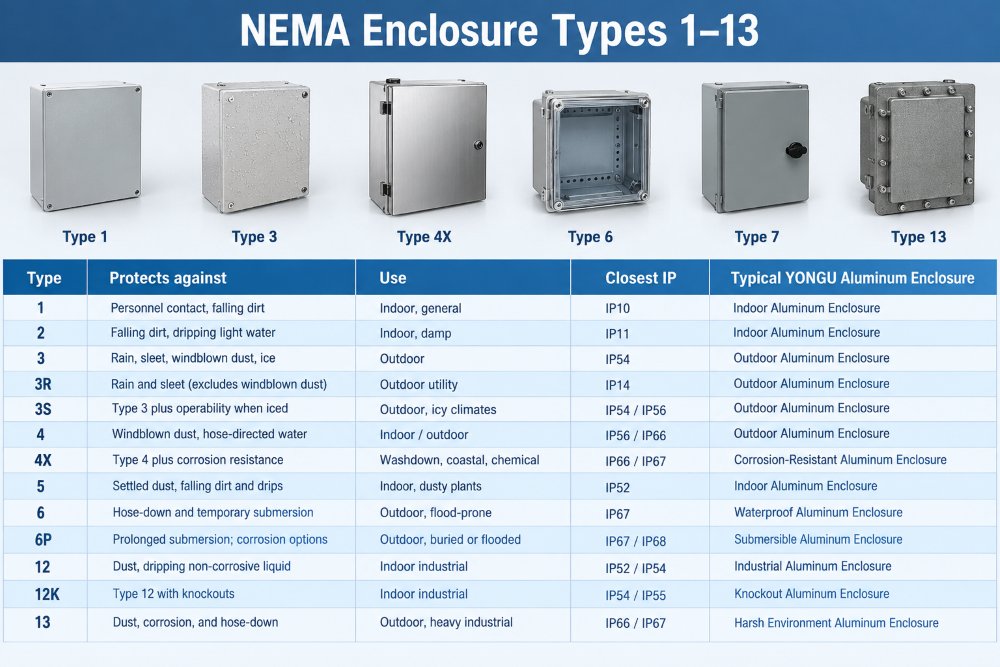
The chart below lists every common NEMA type, the environment it protects against, its closest IP equivalent (an approximate match, not an exact substitute), and the YONGU aluminum enclosure category that typically meets the duty. NEMA and IP are not one-to-one — corrosion, ice, and location are NEMA dimensions no IP number expresses.
| Type | Protects against | Use | Closest IP |
| 1 | Personnel contact, falling dirt | Indoor, general | IP10 |
| 2 | Falling dirt, dripping light water | Indoor, damp | IP11 |
| 3 | Rain, sleet, windblown dust, ice | Outdoor | IP54 |
| 3R | Rain and sleet (excludes windblown dust) | Outdoor utility | IP14 |
| 3S | Type 3 plus operability when iced | Outdoor, icy climates | IP54 / IP56 |
| 4 | Windblown dust, hose-directed water | Indoor / outdoor | IP56 / IP66 |
| 4X | Type 4 plus corrosion resistance | Washdown, coastal, chemical | IP66 / IP67 |
| 5 | Settled dust, falling dirt and drips | Indoor, dusty plants | IP52 |
| 6 | Hose-down and temporary submersion | Outdoor, flood-prone | IP67 |
| 6P | Prolonged submersion; corrosion options | Outdoor, buried or flooded | IP67 / IP68 |
| 12 | Dust, dripping non-corrosive liquid | Indoor industrial | IP52 / IP54 |
| 12K | Type 12 with knockouts | Indoor, pre-punched | IP52 |
| 13 | Oil and coolant seepage and spray | Indoor machine tools | IP54 |
Indoor Ratings (1, 2, 5, 12, 12K, 13)
Indoor NEMA types are about people, dust, and incidental liquid. Type 1 is the default office and cabinet rating — finger contact and falling dirt only, no water protection. Type 2 adds drips and light splashing for damp indoor rooms. Type 5 is the dusty-factory rating: settled dust, falling dirt, and light dripping water. Type 12 is the workhorse of indoor industrial control panels — oil-free dust and dripping non-corrosive liquid — and the closest everyday equivalent is about IP52/IP54; Type 12K adds factory knockouts that keep the rating intact. Type 13 covers oil and coolant seepage, common on machine-tool enclosures. In practice, indoor-rated aluminum enclosures use the same extruded or sheet-aluminum geometry as outdoor ones, but rely on gasketed doors and sealed flanges rather than full immersion seals.
Outdoor Ratings (3, 3R, 3S, 4, 4X, 6, 6P)
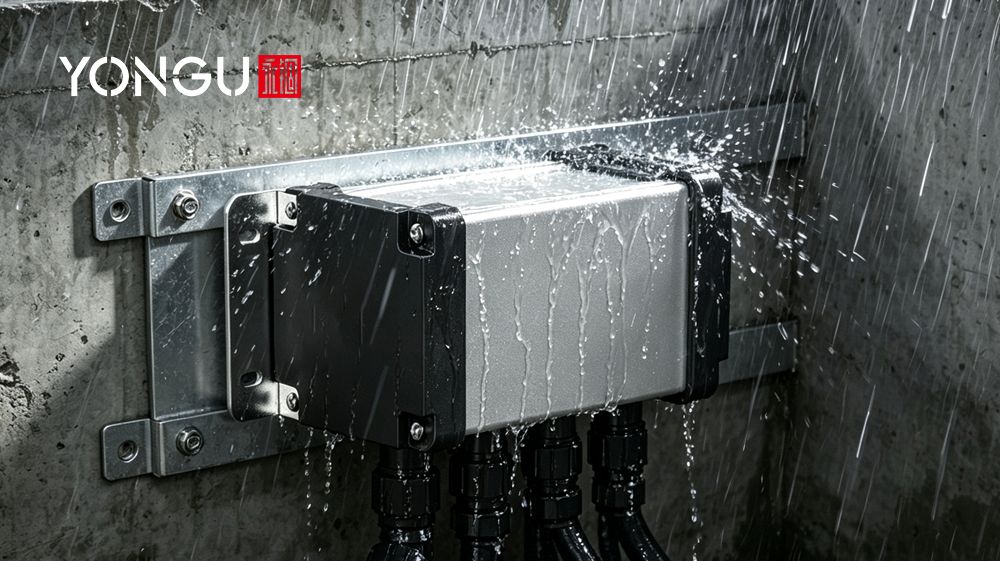
Outdoor types begin where indoor ratings stop. Type 3 covers rain, sleet, windblown dust, and ice formation. Type 3R is the rain-and-sleet utility rating — it deliberately omits windblown dust protection, which is why it appears on millions of pole-mounted transformers and street cabinets. Type 3S keeps the enclosure operable when loaded with ice. Type 4 is the hose-down standard: dust-tight and water-tight against direct spray, used on farm washdown stations, food-area equipment, and exposed control boxes. Type 4X adds corrosion resistance — this is the coastal, chemical, and washdown rating, and it is where anodized aluminum earns its place: a sealed aluminum box with a Type 3 hard anodized surface resists salt spray without the cost of stainless steel. Type 6 handles hose-down plus temporary submersion; Type 6P extends to prolonged submersion, which maps to IP67/IP68 sealed boxes like our IP67/IP68 waterproof aluminum profile enclosure (L06A, 150 × 115 mm). For wall-mounted outdoor gear, the wall-mount waterproof box range and wall-mount aluminum enclosures are the standard starting points for NEMA 3R/4/4X duty.
Hazardous Location Ratings (7, 8, 9, 10)
Types 7, 8, 9, and 10 are a different axis: they protect against ignition of explosive atmospheres as defined by NFPA 70 (NEC) — they do not, by themselves, add dust or water sealing. Type 7 enclosures are explosion-resistant for indoor Class I, Groups A/B/C/D gas locations: the housing contains an internal gas explosion without igniting the surrounding atmosphere. Type 8 serves the same Class I gas groups but through oil immersion. Type 9 is dust-ignition-proof for Class II, Groups E/F/G combustible-dust locations (grain, flour, metal dust), keeping dust out and surface temperatures below ignition limits. Type 10 meets MSHA requirements (30 CFR Part 18) for mining use. When hazardous-location protection is needed, it is certified on a heavy-welded or cast housing, not a standard off-the-shelf aluminum box — YONGU supplies the surrounding non-hazardous enclosures and integration brackets, while the certified hazloc device is sourced from a listed manufacturer.
NEMA to IP Conversion
For export or global OEMs, the question is usually "what IP code matches this NEMA type?" (IP codes are defined in IEC 60529.) The short version: NEMA 1 ≈ IP10, 2 ≈ IP11, 3/3R ≈ IP14–IP54, 4 ≈ IP56, 4X ≈ IP66, 6 ≈ IP67, 6P ≈ IP67/IP68, 12 ≈ IP52/IP54, 13 ≈ IP54. Always read the conversion as "similar protection under typical conditions," never as a certification swap — NEMA 4X carries corrosion and ice duties no IP code expresses, and an IP68 box declares its own immersion depth. For the full two-way chart, test-method differences, and regional guidance, use the companion article NEMA vs IP Rating, and brush up on the IP side with Ingress Protection explained and IP54 to IP68 selection.
How to Select the Right NEMA Rating
Walk the decision path and stop where your environment is fully covered. Step 1 — Indoor or outdoor? Indoor starts at Type 1; add Type 2 if drips, Type 5 if settled dust, Type 12 for industrial control panels, Type 13 for oil and coolant. Step 2 — Outdoor exposure? Type 3 for rain, sleet, and windblown dust; Type 3R if only rain and sleet; Type 3S where ice must not lock the box. Step 3 — Hose-down or spray? Move to Type 4. Step 4 — Corrosion, coastal air, chemicals, or washdown? Move to Type 4X — specify anodized aluminum or stainless hardware. Step 5 — Possible submersion or flooding? Type 6 for temporary, Type 6P for prolonged. Step 6 — Flammable gas, combustible dust, or mining? That selects Types 7/8/9/10 on their own axis, certified by the device manufacturer. Step 7 — Export beyond North America? Add the closest IP code side by side — see IP65 vs IP68 and IP65 vs IP67 for the sealing details. Over-specifying costs money in gaskets, castings, and testing; under-specifying loses the field unit.
Get the right rating before you order. Send YONGU the installation site, whether it is indoor or outdoor, washdown or submersion exposure, and the target standard — we will match an anodized aluminum enclosure, confirm the seal and gasket design, and provide the IP test report. Custom cutouts, gasketed flanges, and NEMA 4X-style anodized finishes ship from MOQ one, with samples in about 5–7 working days. Request a quote through the contact page; IP68 test reports and datasheets are on the downloads page.
FAQs
What is the difference between NEMA 1, NEMA 2, and NEMA 12?
NEMA 1 protects against personnel contact and falling dirt indoors. NEMA 2 adds dripping water and light splashing. NEMA 12 covers industrial dust and dripping non-corrosive liquid indoors — the control-panel standard. 12K is Type 12 with knockouts, and the three are roughly IP10, IP11, and IP52/IP54 respectively.
Which NEMA rating is waterproof?
Type 4 and 4X are hose-down water-tight for rain and directed spray; Type 6 survives temporary submersion; Type 6P handles prolonged submersion. NEMA 3/3R keep out rain but are not hose-down rated. Closest IP codes are IP66 for Type 4/4X and IP67/IP68 for Types 6/6P.
Is NEMA 4X the same as stainless steel?
No — 4X is a performance rating (Type 4 plus corrosion resistance), not a material spec. It can be built from painted carbon steel, stainless steel, or anodized aluminum; anodized aluminum enclosures are the common lightweight choice for 4X-equivalent outdoor duty.
What NEMA rating do I need for outdoor use?
Start at Type 3 (rain, sleet, windblown dust). Use Type 3R if dust is not a concern, Type 4/4X if the box faces hose-down or coastal air, and Type 6/6P if it may be submerged. In icy climates, prefer Type 3S for operability under ice load.
Do NEMA 7/8/9/10 enclosures also keep out water and dust?
Not by default. Types 7–10 protect against ignition in hazardous gas, dust, or mining atmospheres (NEC Class I/II). They are a separate certification axis; if water or dust sealing is also required, specify it as an additional rated enclosure or a listed combination.
What aluminum enclosure is equivalent to NEMA 4X?
A sealed aluminum box with an IP66/IP67 gasket, anodized corrosion-resistant surface, and stainless fasteners typically delivers 4X-equivalent performance for outdoor and washdown duty — for example our wall-mount waterproof aluminum enclosures. For official U.S. certification, the finished assembly should be tested and labeled as required.