Designing electronic devices for outdoor, industrial, or marine environments presents a critical challenge: ensuring long-term reliability against water ingress, dust, and temperature-induced pressure differentials. Standard seals often fail over time due to material degradation or the physical phenomenon known as "thermal cycling." When an enclosure heats up during operation and cools down rapidly at night, a partial vacuum is created, pulling moisture past seals that might otherwise pass standard water tests.
Understanding the mechanical and material factors that govern ingress protection is essential for engineers aiming to prevent premature field failures.
Key Failure Mechanisms in Outdoor Enclosures
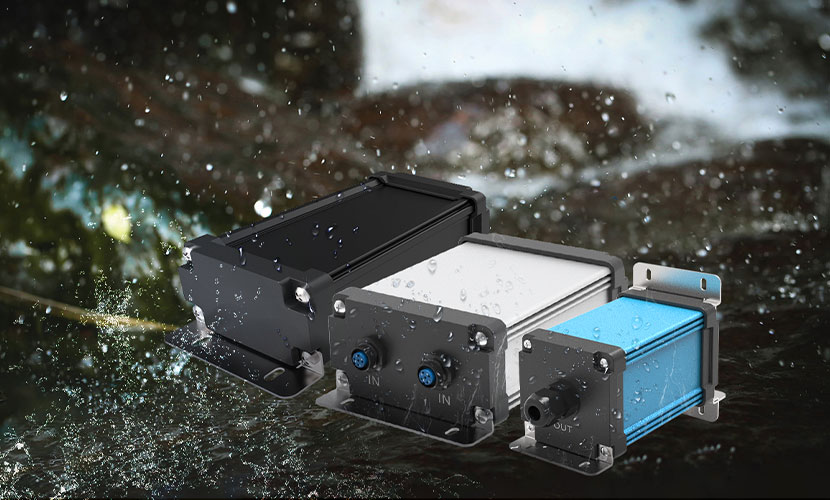
When deploying sensitive control units, sensors, or communication systems outdoors, several environmental stressors act simultaneously on the housing:
- Thermal Expansion and Contraction (The "Breathing" Effect): Internal temperature swings generate pressure differentials between the inside and outside of the enclosure. Without robust sealing or controlled venting, this pressure differential forces moisture through micro-gaps in gaskets or connectors.
- Galvanic Corrosion: When dissimilar metals are used in the presence of an electrolyte (like rainwater or saltwater), galvanic corrosion can degrade the integrity of the enclosure joints, compromising both electrical grounding and IP ratings.
- UV Degradation: Many plastics degrade, embrittle, and crack when exposed to continuous ultraviolet radiation, leading to structural failure and water pathways.
Comparing Enclosure Materials for Harsh Environments
Selecting the right base material is the first step in mitigating these risks. Below is a comparative analysis of extruded aluminum versus standard polycarbonate for demanding applications.
| Selection Parameter | Extruded Aluminum (Anodized) | Polycarbonate (Plastic) |
|---|---|---|
| Thermal Conductivity | High (Acts as an integrated heatsink) | Low (Insulator, traps heat inside) |
| Structural Rigidity | Excellent (Resists impact and high torque on seals) | Moderate (Prone to warping under high torque or heat) |
| UV Resistance | Inherent (No degradation over time) | Variable (Requires UV stabilizers, prone to yellowing) |
| EMI/RFI Shielding | Inherent electromagnetic shielding | None (Requires expensive conductive coatings) |
| Weight | Moderate | Lightweight |
Addressing the Challenges of Ingress Protection (IP)
For demanding deployments, an IP68 rating is frequently specified. Unlike IP67, which tests for temporary immersion (30 minutes at 1 meter), IP68 requires the enclosure to withstand continuous immersion under conditions specified by the manufacturer. Achieving a true, long-lasting IP68 seal requires precise machining tolerances, stable gasket materials (such as silicone or EPDM), and uniform compression along the sealing channels.
However, an enclosure is only as secure as its weakest interface. Cable entries, connectors, and mounting points are the most common sites of water ingress.
A Typical Engineering Scenario: The Outdoor Industrial Gateway
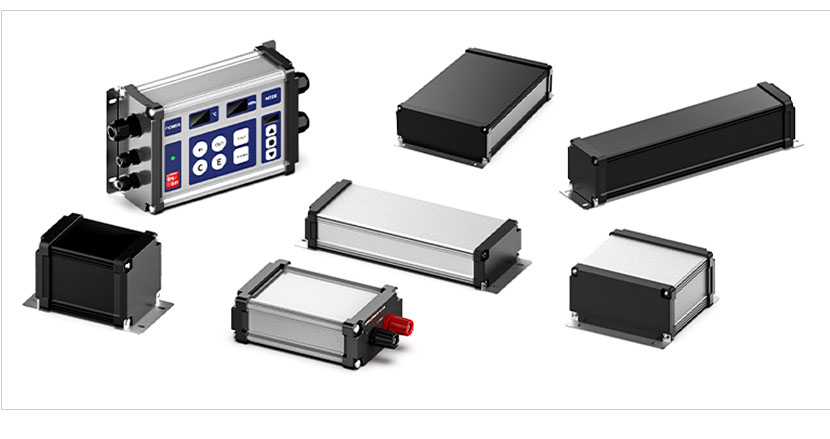
Consider an engineering team designing an outdoor industrial IoT gateway that collects sensor data in a humid coastal environment. The internal electronics generate moderate heat, requiring effective thermal dissipation to prevent component degradation. Additionally, the device needs external connections for power and data transmission, and the enclosure must precisely fit a specific internal PCB size.
Using a plastic enclosure would trap heat, shortening the lifetime of the internal power converters. On the other hand, utilizing a standard metal box without specialized sealing fails when seawater mist bypasses the entry ports. Furthermore, fixed-size enclosures often lead to wasted internal space or force engineers to redesign their PCB layouts.
The team needs an enclosure that offers:
- Excellent heat dissipation via conduction.
- An IP68-certified sealing mechanism that maintains integrity during thermal cycling.
- A highly flexible form factor, allowing the length to be adjusted to match the internal PCB exactly.
- Pre-engineered, customizable endplates that support waterproof circular connectors.
To address these specific requirements, engineers often turn to specialized solutions like the Yonggu M02-80-80mm IP68 Waterproof Electrical Enclosure.
In this product series, M02 represents the specific model type, while 80x80mm denotes the fixed width and height profile. Crucially, because the body is made from high-grade extruded aluminum, the enclosure length can be customized to any arbitrary dimension. This allows engineering teams to optimize space, fitting their electronics precisely without paying for custom tooling. The enclosure also features dedicated sealing grooves with high-elasticity silicone gaskets, ensuring uniform pressure distribution across the endplates, which can be CNC-machined to accommodate various waterproof connectors.
Technical Specifications of the Yonggu M02 80x80mm
To help you evaluate this enclosure for your system architecture, the primary mechanical specifications are outlined below:
| Feature | Specification / Detail |
|---|---|
| Model Series | M02 |
| Cross-Section Dimensions | 80mm (Width) x 80mm (Height) [Fixed Profile] |
| Enclosure Length | Fully customizable to any length based on project requirements |
| Ingress Protection | IP68 (Dust-tight and protected against continuous immersion) |
| Material | Extruded Aluminum Alloy (Body) + Die-cast Aluminum (Endplates) |
| Sealing Material | High-durability silicone O-ring gaskets |
| Mounting Options | Integrated heavy-duty mounting flanges for secure wall or surface installation |
| Customization Services | Custom length cutting, CNC drilling, anodizing colors, laser engraving, and custom endplates |
By using a pre-engineered platform with a customizable length, development cycles are shortened, and the risks associated with designing custom sealing systems from scratch are significantly mitigated.
Frequently Asked Questions (FAQ)
1. What is the key difference between IP67 and IP68 ratings for electrical enclosures?
IP67 enclosures are rated to withstand immersion in water up to 1 meter depth for a duration of 30 minutes. IP68 enclosures are designed for continuous immersion under deeper, more severe conditions, which are defined by the manufacturer and typically verified through rigorous testing. IP68 enclosures provide superior reliability in environments with constant exposure to heavy rain, flooding, or submersion.
2. How does the customizable length of the M02-80-80mm help in design flexibility?
Because the aluminum body of the M02 model is produced via extrusion, it can be cut to any custom length during the manufacturing process. This means you are not restricted to standard catalog lengths; whether your PCB is 100mm, 153mm, or 300mm long, the enclosure body can be cut precisely to fit, saving space and weight in your final installation.
3. How do you prevent internal condensation inside a sealed waterproof enclosure?
Condensation occurs when warm, humid air inside the enclosure comes into contact with the cooler interior walls of the housing. To prevent this, design engineers can install a hydrophobic, breathable vent plug (such as a Gore vent). These vents allow air and pressure to equalize while blocking liquid water and dust, effectively managing internal humidity levels without compromising the IP68 rating.
4. Can the endplates of the Yonggu M02 series be modified for custom connectors?
Yes. The endplates of the M02-80-80mm enclosure are designed to be easily modified. Standard services include custom CNC machining for specific connector cutouts, circular interfaces, cable glands, as well as surface treatments like anodizing and custom labeling to match system requirements.