Content Menu
● Core Screening Standards for a Qualified Supplier
>> 1. Precision CNC Machining and Tolerance Control
>> 2. Advanced Material and Sealing Integration
>> 3. In-House Surface Treatment and Quality Consistency
● Supplier Operating Models: A Horizontal Comparison
● Deep Scenario Analysis: The Hidden Risks of Fragmented Supply Chains
● Scenario-Based Recommendations for Procurement
● Next Steps for a Risk-Free Inquiry
Many procurement managers and hardware engineers operate under a common, yet costly, misconception: they believe that buying a waterproof aluminum electrical enclosure is as simple as finding a supplier who slaps an "IP68" label on their product description. The painful reality usually sets in months later, when outdoor devices start short-circuiting in the field. The culprit? A micro-gap caused by poor machining tolerances or a degraded seal that couldn't handle temperature fluctuations.
When an entire batch of expensive industrial or communication equipment is recalled because of a leaking enclosure, the cost of failure is astronomical. As a B2B buyer, your primary concern isn't just getting the lowest unit price; it's eliminating the risk of project delays, managing supply chain instability, and ensuring absolute field reliability. This guide bypasses the superficial marketing claims and provides a hard-core, engineering-driven framework to help you evaluate and select a truly capable manufacturing partner for your enclosure needs.
Core Screening Standards for a Qualified Supplier
Before requesting a quote, you must look under the hood of a supplier's manufacturing capabilities. If a factory cannot definitively prove its competence in the following three dimensions, even the lowest quote is a trap.
1. Precision CNC Machining and Tolerance Control
A widespread myth in the industry is that a thicker rubber gasket automatically equals better waterproofing. In reality, reliable ingress protection (like IP67 or IP68) relies entirely on the precise dimensional fit between the aluminum extrusion, the end panels, and the sealing groove. If a supplier lacks high-end digital CNC equipment, the resulting uneven surfaces will cause the gasket to compress unevenly, leading to capillary leaks over time. A qualified factory must demonstrate tight tolerance control, ensuring the structural integrity of the enclosure matches your 3D CAD models perfectly.
2. Advanced Material and Sealing Integration
Standard off-the-shelf aluminum boxes often fail in harsh environments due to material degradation. You need to verify what materials the factory actually uses. For high-grade waterproof applications, AL 6063-T5 or AL 6061 aluminum alloys are standard for their strength and corrosion resistance. Furthermore, ask about their sealing application process. Are they manually inserting cheap rubber strips, or do they use automated composite foam dispensing seals and custom-molded silicone rubber pads? The latter is non-negotiable for true IP68 compliance.
3. In-House Surface Treatment and Quality Consistency
We often see clients come to us deeply frustrated by their previous suppliers because the anodizing or sandblasting processes altered the dimensions of the sealing grooves, ruining the waterproof rating. This usually happens when a small machine shop outsources surface treatments to third-party vendors, losing all quality control. A reliable source factory must have its own automated sandblasting and anodizing lines to ensure that surface finishing does not compromise the functional geometry of the enclosure.
Supplier Operating Models: A Horizontal Comparison
To further reduce your trial-and-error costs, it is crucial to understand the structural differences between the types of vendors quoting your project. Here is a breakdown of the typical supply chain models:
| Evaluation Dimension | Trading Companies | Single-Process Workshops | Integrated Source Factory (e.g., Yonggu Enclosures) |
|---|---|---|---|
| Price Structure | High (Includes middleman markup) | Low (Often achieved by cutting corners on materials) | Transparent and competitive for both custom and scalable runs. |
| Customization & R&D | None. Only sells standard stock. | Basic hole-punching. Cannot balance EMC, heat dissipation, and sealing. | In-house industrial design team; full structural DFM capability. |
| Quality & IP Rating | Unverifiable. Batch inconsistencies are common. | High risk of failure. Sealing and surface treatments are outsourced. | Strict IP65 to IP68 standards (L, M, MH, MJ series) with internal quality control loops. |
| Delivery Time | Fast for stock, extremely slow for modifications. | Unstable. Often delayed due to outsourced steps. | JIT digital system; supports 24-hour sampling and fast mass production. |
Deep Scenario Analysis: The Hidden Risks of Fragmented Supply Chains
Imagine you are developing a new outdoor telecommunications diagnostic device. You source the aluminum profiles from Supplier A, send them to Workshop B for CNC machining, and then to Vendor C for anodizing. During final assembly, you discover that the custom silicone seals don't fit the end panels properly, and the device fails its IP67 water immersion test.
Who takes the blame? Supplier A claims the material is fine; Workshop B blames the anodizing thickness; Vendor C blames the original machining tolerances. You are left with scrapped parts, a blown budget, and a missed product launch window.
This is the fatal flaw of fragmented procurement. When dealing with waterproof enclosures, design, machining, and surface treatment are highly interdependent. Yonggu Enclosures operates a 12,000-square-meter intelligent manufacturing base with over 160 advanced CNC machines and fully automated surface treatment lines precisely to prevent this nightmare. By keeping the entire process—from 5052-H32 / 6063 aluminum selection to laser engraving and final assembly—under one roof, the responsibility is singular, and the quality is guaranteed.
Scenario-Based Recommendations for Procurement
Based on your specific project stage and application environment, here is how you should approach your purchasing decision:
• If you are building indoor, low-risk prototypes: Standard off-the-shelf enclosures from a reputable distributor may suffice to save initial costs.
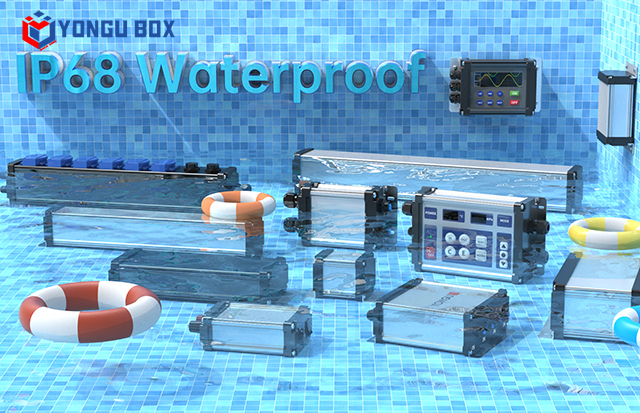
• If you are developing outdoor agriculture equipment, marine electronics, or harsh-environment industrial controls: You require a dedicated IP67 or IP68 solution. We highly recommend exploring our L Series (IP68) or M Series (IP68) waterproof aluminum enclosures. These are designed specifically to balance extreme weather resistance with necessary heat dissipation for internal electronics.
• If you need agile R&D iteration: Look for a partner that supports low-volume, high-mix production. The ability to order custom enclosures starting from a 1-piece minimum order quantity (MOQ) is vital for hardware startups and engineering labs trying to iterate quickly without heavy tooling costs.
Next Steps for a Risk-Free Inquiry
Evaluating an enclosure manufacturer shouldn't be a gamble. To ensure your custom waterproof aluminum electrical enclosure meets every specification without hidden costs, follow this structured approach when reaching out to us:
• Prepare your files: Send us your 3D CAD files (STEP/IGES) and a brief description of your operating environment (e.g., underwater depth, UV exposure, EMC shielding requirements).
• Request a DFM Evaluation: Our engineering team at Yonggu will conduct a free Design for Manufacturability (DFM) check to identify potential sealing failures or cost-reduction opportunities before any metal is cut.
• Test the speed and quality: Take advantage of our 24-hour rapid sampling capability. We will produce a prototype for your physical testing, backed by a strict NDA to protect your intellectual property. If the first article does not meet the agreed-upon tolerances and waterproof standards, we will remake it at no cost to you.
Are you ready to eliminate supply chain headaches and secure a truly watertight solution for your next hardware project? Send us your design requirements today, and let our engineering team build the exact enclosure your technology deserves.